
Introduction
Most teams we work with know their operations need to change. The spreadsheets are out of control. Information lives in people's heads. Reports take too long to produce. Nobody has the full picture when a decision needs to happen fast.
The tools to fix this exist right now. AI-powered analytics, automated workflows, connected platforms with real-time data, AI assistants like Claude helping with daily admin work. This is not some future state. Companies across marine engineering, public institutions, hospitality, fitness and facility management already run on these tools. And the results are measurable: less wasted time, fewer errors, lower operating costs, better data for every decision.
Here is the problem we keep seeing, though. Organizations buy the software. They set up the system. And nothing changes. At Workspace, we have built digital tools for 50+ businesses. The pattern repeats on nearly every project. Technology is the easy part. Getting your processes right and your people on board is where AI-driven digital transformation succeeds or fails.
This is not a software purchase. It is a shift in how your team thinks about work, uses data, and makes decisions. AI assistants, automated scheduling, predictive analytics, connected dashboards: these are the tools. Your processes and your people are the foundation.
This post is for business owners and operations managers who know their workflows need upgrading but are not sure where to begin. We walk through why teams resist the change, where companies get stuck, and the phased approach we use at Workspace to make AI-driven digital transformation work in practice.
The challenge: why companies get stuck
Every company we talk to faces some version of the same problem. The daily work happens in a mix of spreadsheets, emails, phone calls, and informal systems people built because the official process does not work. Data lives in silos. Reporting is slow. Decisions get made on gut feeling because the information to make better ones is scattered across five different tools and three people's notebooks.
AI-driven digital transformation is supposed to fix this. And it does, when the approach is right. But most organizations hit three walls before they get there.
The process problem
Here is something we always tell clients: digitizing a broken process does not fix the process. It speeds up the dysfunction.
If your work order flow is a mess on paper, making it digital creates a faster mess. If your service reports depend on one person's memory, an app will not fix the knowledge gap. If approvals bounce through six email threads before anything gets signed, a digital form speeds up the bouncing but does not solve the bottleneck.
We have watched this play out with our own clients. When we started working with Capax, a marine engineering company in Šibenik, their service technicians tracked hours by hand. Overtime was controlled through spreadsheets. Service reports, the core document they use to verify completed work for clients and prepare invoices, were created manually every single time. The data to run their business existed, but it was scattered across disconnected files, handwritten logs, and conversations.
Before we built anything, we had to understand how work moved through their organization. Where did jobs stall? What information was missing at the point of decision? Which workarounds had become so normal the team did not even recognize them as problems?
This is the process problem most companies face. The workflows have been patched together over years. They work well enough to keep things running. But they are full of hidden inefficiencies nobody has time to step back and examine. AI and analytics have nothing useful to work with until the processes feeding them are clean.
Employee resistance is normal, and reasonable
Getting people to change how they work every day is the hardest part of any digital transformation. We say this after working on dozens of projects across different industries. And honestly? The resistance makes sense.
Your team members know their work. They have systems, even if those systems are informal. They trust what has worked before. When you introduce new technology, especially anything with "AI" in the name, people get nervous.
Some worry AI is going to replace them. Others see new software as management adding bureaucracy without understanding what the real work involves. Both reactions are completely reasonable responses to change introduced without context.
We have watched it happen firsthand. A brand new system gets deployed, and weeks later the team is still using the old way because nobody walked them through why the change matters or how it affects their daily routine. Getting people on board is often harder than getting the technology right. And if you skip this step, the system sits unused no matter how good it is.
When we were building Serwizz, our CMMS platform for service and maintenance teams, the resistance patterns we saw across client organizations were consistent. Technicians with 20 years of experience do not want an app telling them how to do their job. They want a tool making the annoying parts of their job disappear: the paperwork, the duplicate data entry, the hours spent on reports instead of skilled work. Once people see the new system doing this, the resistance fades. But getting to the point where they see it takes effort, communication, and patience.
Leadership has to show up
The third wall is leadership. We have seen this more times than we would like. A manager gets excited about going digital. They approve the budget, sign the contract, hand it off to someone else, and move on to the next thing.
AI-driven digital transformation requires ongoing attention from the top. Not micromanagement. Attention. When leaders actively participate in the rollout, use the new tools themselves, and demonstrate commitment to the change, teams follow. When leaders treat it as someone else's project, the initiative stalls.
We experienced this clearly on our work with DES, a public sector institution in Split. DES needed to digitize their employee time and attendance tracking and integrate it with their existing Pantheon ERP system. Public sector organizations often have more layers of decision-making and more entrenched habits than private companies. The project succeeded because Marko Baričević, Head of Technical Department and Investment Projects, stayed involved throughout the process and kept the communication channels open between our team and theirs.
Without someone like Marko on the client side pushing things forward, the same project would have taken twice as long and delivered half the value.
The solution: a phased approach to AI-driven digital transformation
Going from spreadsheets and phone calls to AI-powered operations does not require a big bang rollout. It requires a clear plan, the right sequence, and a partner who understands both the technology and the human side.
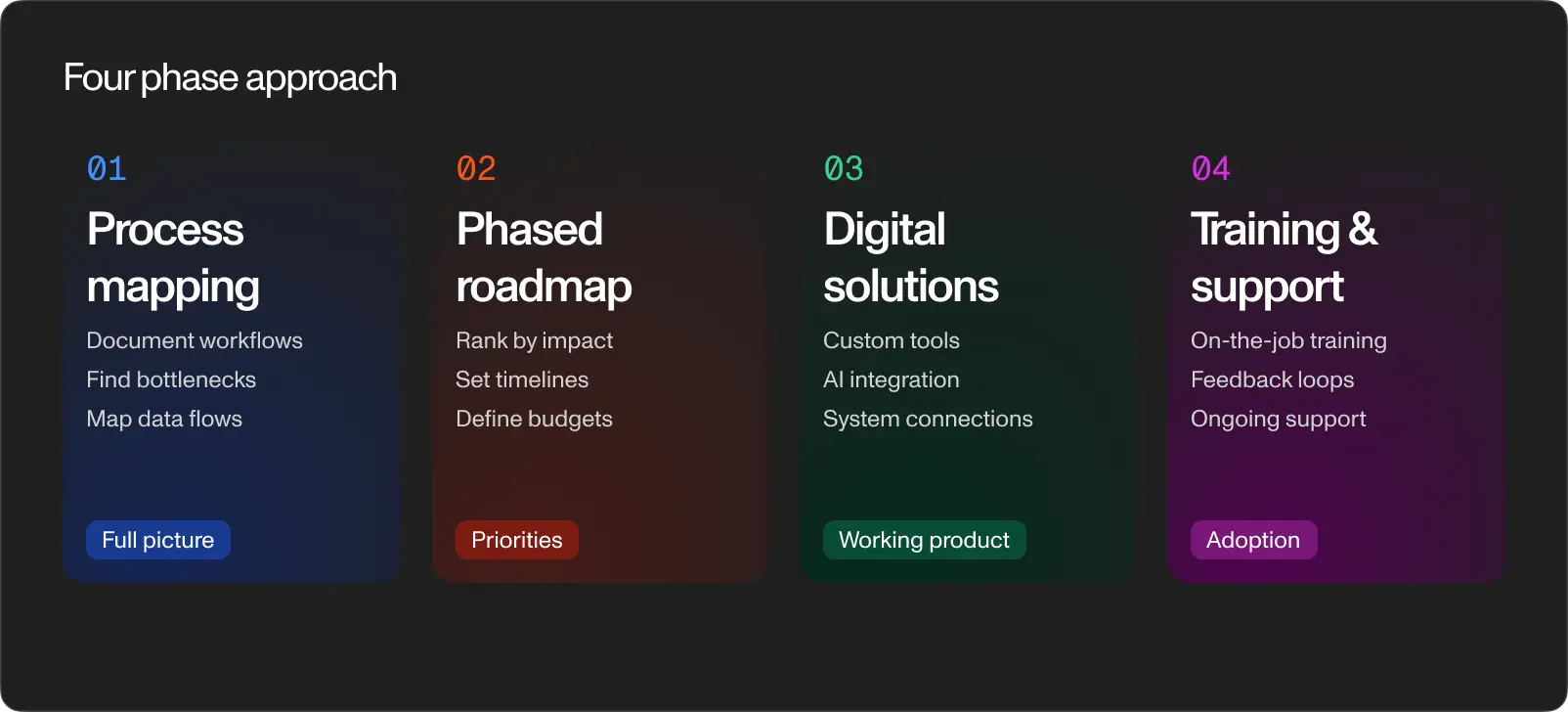
At Workspace, we follow a four-phase approach: process mapping, phased roadmap, digital solutions, and training and support. Every project we take on follows this sequence. It works because it puts process and people before technology, every time.
Phase 1: process mapping
Before we write a single line of code, we map how work flows through your organization today.
This means sitting with your team and documenting everything: how tasks get created and assigned, where information lives, how decisions get made, what tools people use (and which ones they avoid), and where the informal workarounds are.
With Capax, this process mapping phase revealed things their management did not know. Technicians were keeping private spreadsheets with equipment notes because the shared system was too slow and outdated. Those personal notes contained the best operational intelligence in the company, and nobody at the management level had access to it. The data existed. The problem was the process for capturing and sharing it.
With DES, process mapping showed us the gap between how attendance was being tracked and what the Pantheon ERP system needed as input. Manual clock-ins and disconnected records meant someone had to re-enter data by hand for payroll and HR. Every re-entry point was a potential error. Once we mapped the full flow, the solution became clear: contactless NFC card sign-in feeding data directly into the ERP without any manual steps in between.
The goal of process mapping is simple. You need the full picture of how work happens today before you change anything. Skip this step and you risk building software on top of broken workflows.
Phase 2: phased roadmap
Once you see the full picture, you rank problems by impact and create a plan with priorities, timelines, and budgets. The key word is phased. Not everything at once.
In our experience, the highest-impact starting points fall into a few common areas:
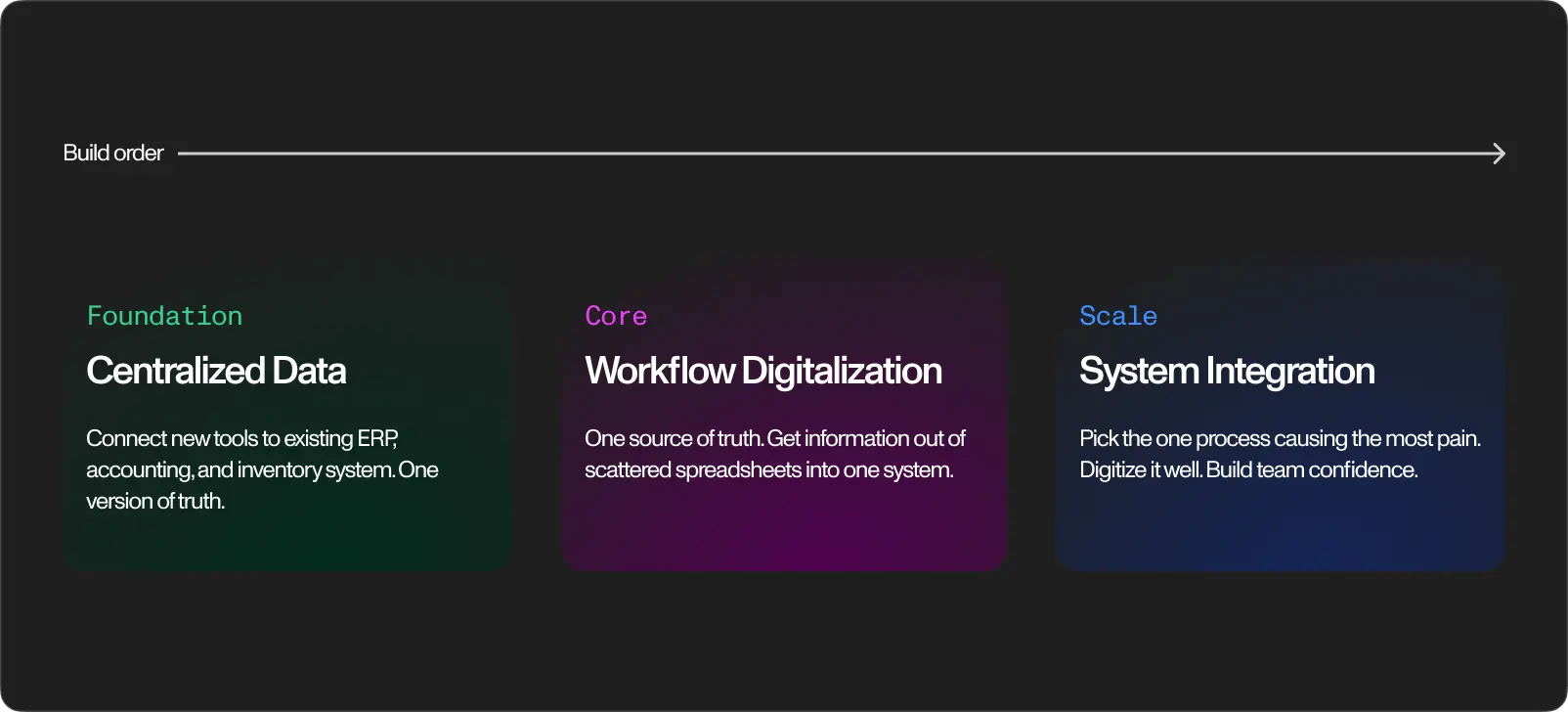
Centralized data. Get your information out of scattered spreadsheets and into one system. This single change, having one source of truth, makes everything else possible. AI-driven analytics, predictive algorithms, automated alerts: they all need clean, structured, centralized data. If your records live in a dozen files and someone's head, you know what needs fixing first.
Core workflow digitization. Pick the one process causing the most pain and digitize it well. For Capax, this was the service report. For DES, it was clock-in/clock-out. For Serwizz clients in facility management and manufacturing, it is usually work order management. One visible win builds team confidence and creates momentum for the next step.
Integration with existing systems. Your new tools need to talk to the systems you already run. Your ERP, your accounting software, your inventory tools. Disconnected platforms create more data silos. Connected systems give everyone one version of the truth. When we built the DES time tracking system, integrating with Pantheon ERP was not optional. It was the entire point. Without the integration, you have a nicer-looking attendance tool feeding the same manual re-entry process.
The phased roadmap protects you from the biggest digital transformation mistake: trying to change everything at once. Start small, prove value, expand from there.
Phase 3: digital solutions
This is where the technology comes in. And this is where AI enters the picture in a meaningful way.
At Workspace, we build custom digital tools tailored to how your team works. Not off-the-shelf software you need to bend your processes around. Custom solutions designed for your specific workflows, your data, and your industry.
For Capax, we built a web and mobile application with offline access for technicians working in shipyards with poor connectivity. The app handles work logging, spare parts tracking, digital service reports with multi-language PDF export, and analytics dashboards for management. Their technicians went from handwritten logs to digital reports they complete on their phones between jobs. The result: 20% less time per person on administration and teams completing 10% more tasks daily.
For DES, the solution was a time and attendance system with contactless NFC card authentication, direct Pantheon ERP integration, and clean digital records replacing manual processes. Simple, focused, effective.
For service and maintenance teams, we built Serwizz: an AI-powered CMMS handling work orders, preventive maintenance scheduling, asset tracking, mobile access with offline mode, and analytics dashboards. Serwizz includes an AI assistant for faster work order creation, document summaries, and smart suggestions. A logistics facility using Serwizz cut response time by 45% and achieved zero stockouts on critical parts in the first quarter. A shipyard client saw 30% improvement in operational efficiency.
AI shows up at this stage in several ways. AI-driven analytics identify patterns in your data humans would miss. Predictive algorithms flag problems before they escalate. AI assistants like Claude help teams draft reports, summarize records, generate standard procedures, and analyze logs. These tools do not replace your people. They take care of the repetitive, time-consuming administrative work so your team focuses on the tasks requiring human judgment, experience, and skill.
The key is timing. AI-powered tools deliver value when they have clean data to work with and a team ready to act on their outputs. Introduce them too early, before your processes are solid and your data is centralized, and they produce noise instead of insight.
Phase 4: training and support
This is where most digital transformation projects either succeed or fail. And it is the phase too many companies treat as an afterthought.
At Workspace, training and support is not a one-day workshop at the end of the project. It runs parallel to the entire engagement.
A few things we have learned over the years about making adoption work:
Involve your team from day one. The people doing the daily work know the problems better than anyone. Their input shapes better tool configuration and faster adoption. When we built the Capax app, the technicians and managers who would use it daily were part of the conversation from the process mapping phase through final testing. Their feedback shaped the mobile interface, the offline functionality, and the reporting workflows.
Train in context, not in a classroom. Show people how the new system works on their equipment, in their workflow, during their shift. We ran generic training sessions early on in one project, and retention was low. Switching to on-the-job walkthroughs changed everything. People learn by doing, on their own tasks, in their own environment.
Be direct about AI. AI in the workplace does not eliminate jobs. It eliminates tedious administrative work. It surfaces data faster. It helps people focus on the work requiring human skill and experience. Say this clearly and back it up with specifics. Show your team which manual tasks disappear and what they get to spend more time on instead. When we talk to service teams about Serwizz, we explain how the AI assistant handles document generation and data analysis so technicians spend more time on skilled work and less time filling out forms.
Create feedback loops. Give the team a way to flag problems, suggest improvements, and share what works. The people using the system every day are your best source of insight on whether it helps or gets in the way. Their feedback drives the ongoing improvements.
Stay close after launch. Digital transformation does not end when the system goes live. At Workspace, we stay with our clients after delivery: fixing issues, shipping improvements, and adapting the tools as needs change. The Capax and DES projects both include ongoing support because a tool left alone after launch starts falling behind the team's needs within months.
AI-driven digital transformation creates new possibilities for your team. People move from manual data entry to data-informed planning. From guessing to scheduling based on real analytics. From chasing problems to preventing them. These are better roles, not fewer roles. Making sure your team sees and believes this is your job as a leader.
What comes next
If you have read this far, you already know your operations need to change. The question is where to start.
The answer is always the same: start with your processes and your people. Map how work flows today. Identify where you lose the most time and money. Build a phased plan. Bring in AI-powered tools when your data and your team are ready for them. And work with a partner who understands both the technology and the human side.
At Workspace, we have done this for marine engineering companies, public sector institutions, hospitality groups, charter businesses, and service teams across multiple industries. The technology changes per project. The approach stays the same: process mapping, phased roadmap, digital solutions, training and support.
If your team is still running on spreadsheets, manual reports, and disconnected tools, a conversation about where to begin is a good next step. Reach out to book a discovery session.