
A charter agency in Dalmatia sent us a project brief last month. They had a working prototype built with Claude. Frontend screens, UX flow, calculation logic. The technical specification (also generated by AI) stated:
"The developer is NOT starting from zero. Frontend design, UX flow, and calculation logic are ~80% defined. The work is: productionize, add backend/database, connect CRM, make it scalable."
Eighty percent done. Sounds like the hard part is over.
It is not.
This is the new pattern in software development. Non-technical founders and business teams now build functional prototypes in hours using tools like Cursor, Lovable, Bolt, and Claude. Vibe coding went from zero to a $4.7 billion market in under a year. Andrej Karpathy coined the term in early 2025, and Collins Dictionary named it Word of the Year before the year was over. The kicker: 63% of people using these tools are not developers.
The prototypes look real. They have screens, buttons, forms, and even database connections. They run on your laptop. They impress investors in demo meetings. And they break the moment real users show up.
This post breaks down what "productionize" means in practice, why the gap between prototype and production is wider than most founders expect, and how to close it without starting over. If you are a founder, product owner, or CTO sitting on a vibe-coded prototype right now, this is the roadmap for what comes next.
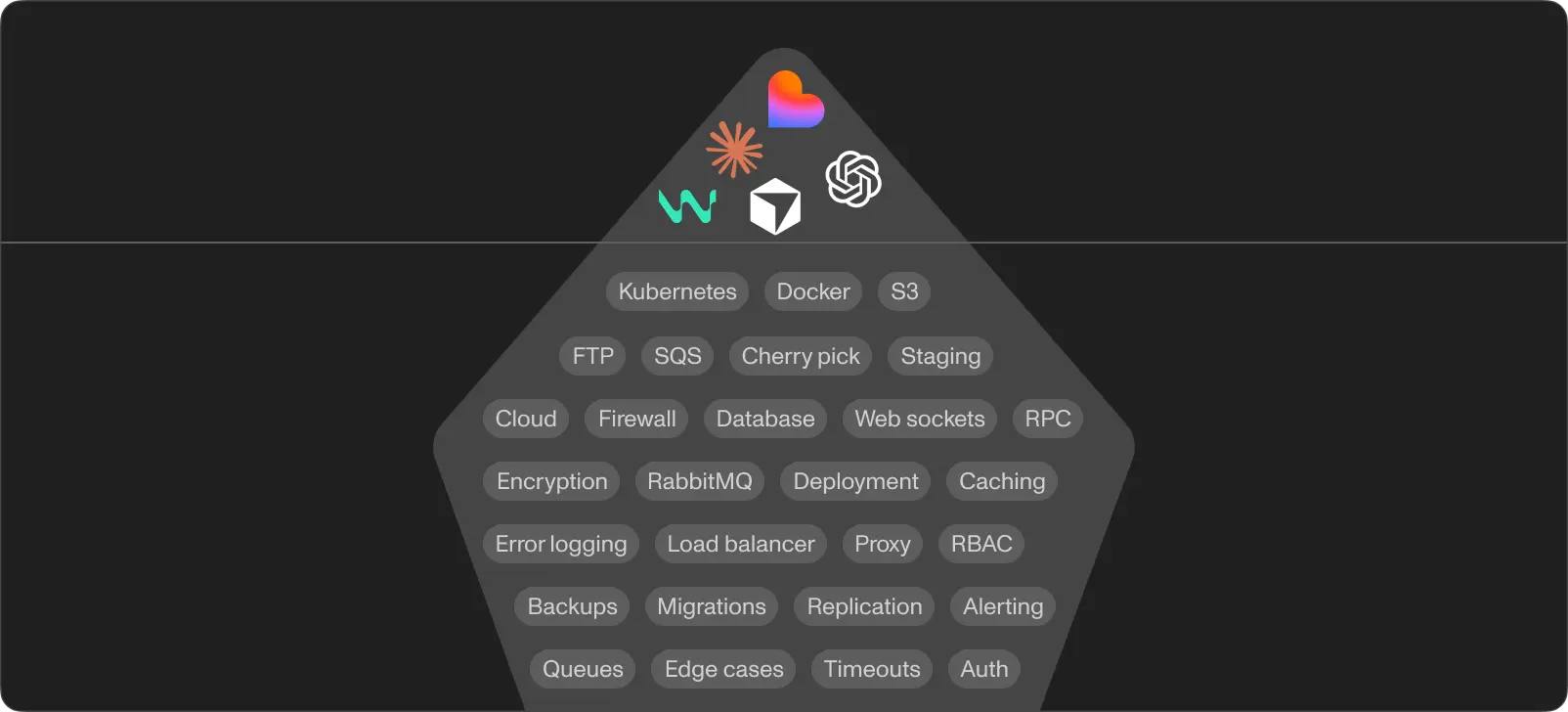
The prototype looks done. It is not.
Your code has no foundation
AI-generated code optimizes for one thing: making the demo work. It picks the shortest path from prompt to output. The result is code with no architecture, no separation of concerns, and no patterns a team of engineers would follow.
When we audit vibe-coded projects, we find the same problems every time. Business logic mixed into UI components. No error handling beyond the happy path. Config values baked directly into the source code (good luck changing your Stripe key per environment). Database queries written inline instead of through a data layer. Authentication implemented as an afterthought, if at all.
The AI also makes decisions you never asked it to make. It picks a database driver. It chooses a state management approach. It selects an authentication library. These choices are not wrong per se. They are arbitrary. They do not follow a coherent technical strategy. And when you need to change one of them six months later, you find it is wired into everything.
A CodeRabbit analysis of 470 pull requests found AI-generated code carries 1.7x more major issues and 2.74x higher security vulnerability rates compared to human-written code. The prototype passes the eye test. The codebase does not pass a code review.
Your infrastructure does not exist
The prototype runs on localhost or a single cloud instance. There is no staging environment. No CI/CD pipeline. No automated tests. No monitoring. No logging. No alerting.
When the charter agency sent us their prototype, they had a Vercel deployment with no environment separation. Every change went straight to the live URL. No rollback capability. No database backups. No error tracking.
This works when you are the only user. It fails when your first 100 customers start booking yachts at the same time.
Deployment is a discipline, not a button. "Click deploy" works until you push a broken release on a Friday evening and need to roll back. Without a pipeline, your recovery plan is "fix it manually in production." Ask anyone who has done this at 2 AM whether it is a sustainable strategy.
Security is missing, not optional
Gartner estimates 60% of all new code will be AI-generated by the end of 2026. Research shows 45% of AI-generated code contains security vulnerabilities. Combine those two numbers, and you see the scale of the problem.
Vibe-coded prototypes store API keys in frontend code. They skip input validation. They use default database credentials. They have no encryption at rest or in transit. They expose admin endpoints without authentication.
One leaked API key turns your weekend project into a data breach. For industries handling financial transactions or personal data (charter bookings, payment processing, customer records) this is a legal liability, not a technical footnote.
The trust gap is growing
Developer trust in AI-generated code dropped from 40% to 29% in a single year. The people closest to the code trust it less, not more, as adoption grows. Non-technical founders see a working screen. Engineers see missing tests, unhandled edge cases, and implicit assumptions the AI made without telling anyone.
This is the core tension of vibe coding in 2026. The tool is fast enough to produce something convincing. It is not thorough enough to produce something reliable. The gap between "it works on my screen" and "it works for 10,000 users" is the gap between a prototype and a product.
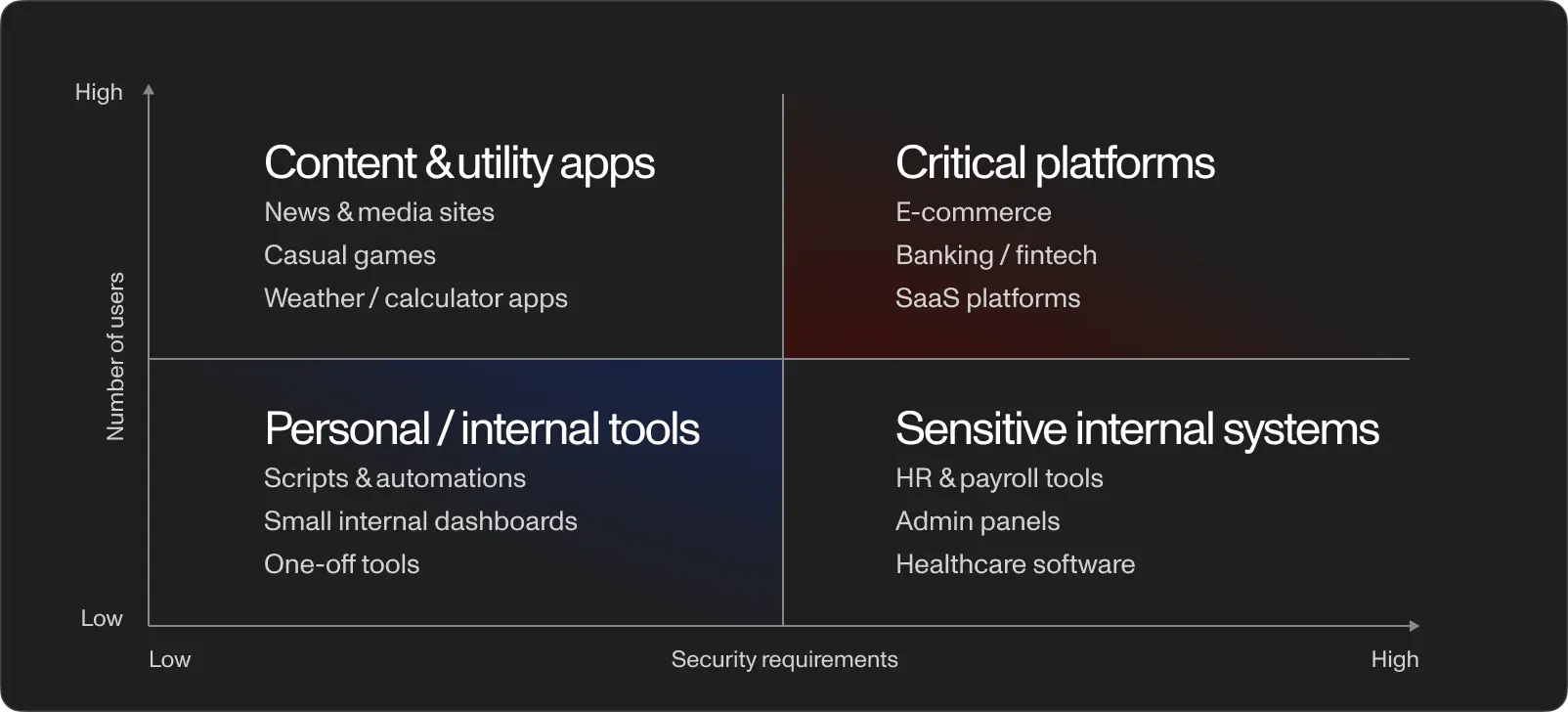
What "productionize" means in practice
The charter agency's brief treated "productionize" like a checkbox. One task, one line item. In reality, it is five or six engineering disciplines stacked on top of each other, and each one carries its own timeline and complexity.
Restructuring the code
Here is what we do first when a vibe-coded project lands on our desk. We open the codebase and map it. What did the AI build? What holds up under scrutiny? What needs to go?
The answer is always the same mix. The frontend looks decent. The logic underneath is spaghetti. Business rules live inside React components where they should live in service layers. The AI typed any everywhere in TypeScript because strict typing slows down generation. Database calls sit inline in page components instead of going through a proper data layer. Error handling covers the happy path and nothing else.
We do not start over. We separate frontend from backend from data access. We add real types. We write tests. We restructure the code into something a team of three or four engineers will maintain for years without wanting to burn it down.
Getting deployment right
Your prototype lives on a single Vercel instance. There is no staging environment, no test pipeline, nothing between "save file" and "it's live." Every push goes straight to production.
We set up the full pipeline in the first week. Docker containers so the app runs identically on every machine. A CI/CD flow where tests run on every pull request and broken code never reaches the live URL. A staging environment where the client reviews changes before they ship. Infrastructure defined in code (we use Terraform or AWS CDK) so spinning up a new environment takes minutes, not days. And rollback procedures, because at some point a release will go sideways at 2 AM, and "fix it live" is not a plan.
Security and compliance
This one is non-negotiable, and it is where vibe-coded projects are weakest.
We check for the obvious problems first: API keys sitting in frontend code, default database passwords, admin routes exposed without authentication, zero input validation. Then we build the security layer properly: session management, secrets stored in vaults, data encrypted in storage and in transit, audit logging, rate limiting, dependency scanning.
Think about what a charter platform handles. Credit card numbers. Passport scans. Booking contracts worth tens of thousands of euros. GDPR applies. PCI compliance applies. When we built payment flows for charter clients in Dalmatia, the compliance rules shaped the entire system architecture. You do not patch this in later. You build around it from the start.
Observability
Nobody installs monitoring on a prototype. Then the prototype goes live, and nobody knows it went down until a customer emails.
Production systems need APM tracking response times and error rates. They need structured logs you search and filter, not console.log scattered across files. They need alerts: if the API response time crosses 500ms or the error rate spikes, someone gets a Slack notification. They need uptime checks on critical endpoints. They need database performance tracking, because slow queries kill user experience faster than downtime does.
We configure all of this in the first sprint, not the last. By the time real users arrive, we know about problems before they do.
Scalability
Here is where the charter agency's prototype fell apart in our review. It fetched boat availability with a direct API call on every page load. One user browsing: no problem. Fifty users on a Saturday morning during peak booking season? The upstream API rate-limits you, the page hangs, and your customers book somewhere else.
Production code handles this differently. You batch API calls. You cache availability data and refresh it on a schedule. You queue heavy operations in the background so page loads stay fast.
We know this from experience. Our platform Boat4You pulls data from multiple booking systems daily: 13,752 yachts across 1,559 agencies, with 236,647 images. We designed the sync architecture, caching layer, and retry logic from scratch. No AI tool would have generated any of it, because no AI tool has ever run a booking platform under real load during charter season in Split.
How to bridge the gap without starting over
Here is the good news: you do not need to throw away your prototype. The 80% the AI built has value. It validated your idea. It showed you the UX. It gave your development team a head start.
The approach we use at Workspace for vibe-coded projects follows a clear sequence.
-
Audit first. We review the existing codebase, identify what survives into production, and map what needs to be rebuilt. This takes days, not weeks. The output is a clear scope document with cost estimates.
-
Keep the UX, rebuild the engine. The screens and flows the AI generated are often the strongest part. We keep what users see and gut what runs behind it. New architecture, same experience.
-
Ship incrementally. We deploy a production environment from day one and release features in iterations. The client sees progress every week, not after three months of silence.
-
Automate everything. Tests, deployments, monitoring, and alerts are set up in the first sprint. Not the last.
-
Transfer knowledge. The founder understands the product. The engineers understand the code. We bridge the two by documenting decisions, explaining tradeoffs, and making sure the client's team owns the system after handoff. No black boxes.
Vibe coding compresses weeks of discovery work into hours. A founder with a working prototype walks into our first meeting with a shared understanding of what they want. No abstract wireframes. No ambiguous requirements. A working demo.
This changes the economics of software development. The discovery phase gets shorter. The feedback loop gets tighter. The total cost of going from idea to production drops. Not because the engineering work disappears, but because the starting point moves forward.
We use AI tools in our own workflow. Claude helps us analyze project requirements. AI-assisted estimation draws on our historical time-tracking data across hundreds of tasks. We are not skeptical of AI. We build with it daily. We also know where it stops and engineering takes over.
The teams winning right now are the ones treating vibe coding as a discovery tool and professional engineering as the delivery method. Prototype fast. Validate with real users. Then build the production system with the confidence you are building the right thing.
The vibe coding wave is not slowing down. Non-technical user adoption surged 520% year-over-year. GitHub reports 46% of all new code is now AI-generated. This means more founders will walk into meetings with working prototypes. More of those prototypes will need professional engineering to reach production. The market for "productionization" is growing faster than the market for building from scratch.
Start with what you built
If you have a vibe-coded prototype and you are wondering what comes next, the answer is an audit. Not a rewrite. Not a six-month project plan. A focused review of what you have, what works, and what it takes to get to production.
We run these audits for founders and product teams who built with AI tools and need to ship to real users. Book a consultation to find out where your prototype stands and what it takes to go live.