
Introduction
Every founder hits the same wall. You have an idea. You know the problem it solves. But between having the idea and having something real to show, there is a gap most teams fill with slide decks, requirements documents, and weeks of back-and-forth meetings.
By the time a traditional process produces something testable, the assumptions baked into it are stale. The market moved. The investor meeting passed. The co-founder lost patience. And the requirements document nobody reads is 40 pages long.
We run AI-driven prototyping sprints at Workspace. The goal is simple: take a raw idea and produce a working, demo-ready proof of concept in days. Not weeks. Not months. Days. We do this through three formats depending on what you need to achieve: a AI Discovery Sprint, an Pitch-Ready Prototype, or a AI Proof of Concept.
This matters because speed of validation is now a competitive advantage. The cost of a wrong assumption goes up every day it stays untested. A working prototype you put in front of real users or investors in week one tells you more about your product direction than three months of planning.
This post walks through how we do it, what each sprint format delivers, and why AI compresses the timeline without cutting corners on the thinking.
How we do it
We have run this process enough times to know what works and what wastes time. The method comes down to four stages. Each one feeds directly into the next. There is no dead space between them, and AI accelerates every stage without replacing the human decisions where it matters.
Stage 1: Discovery session (recorded and transcribed)
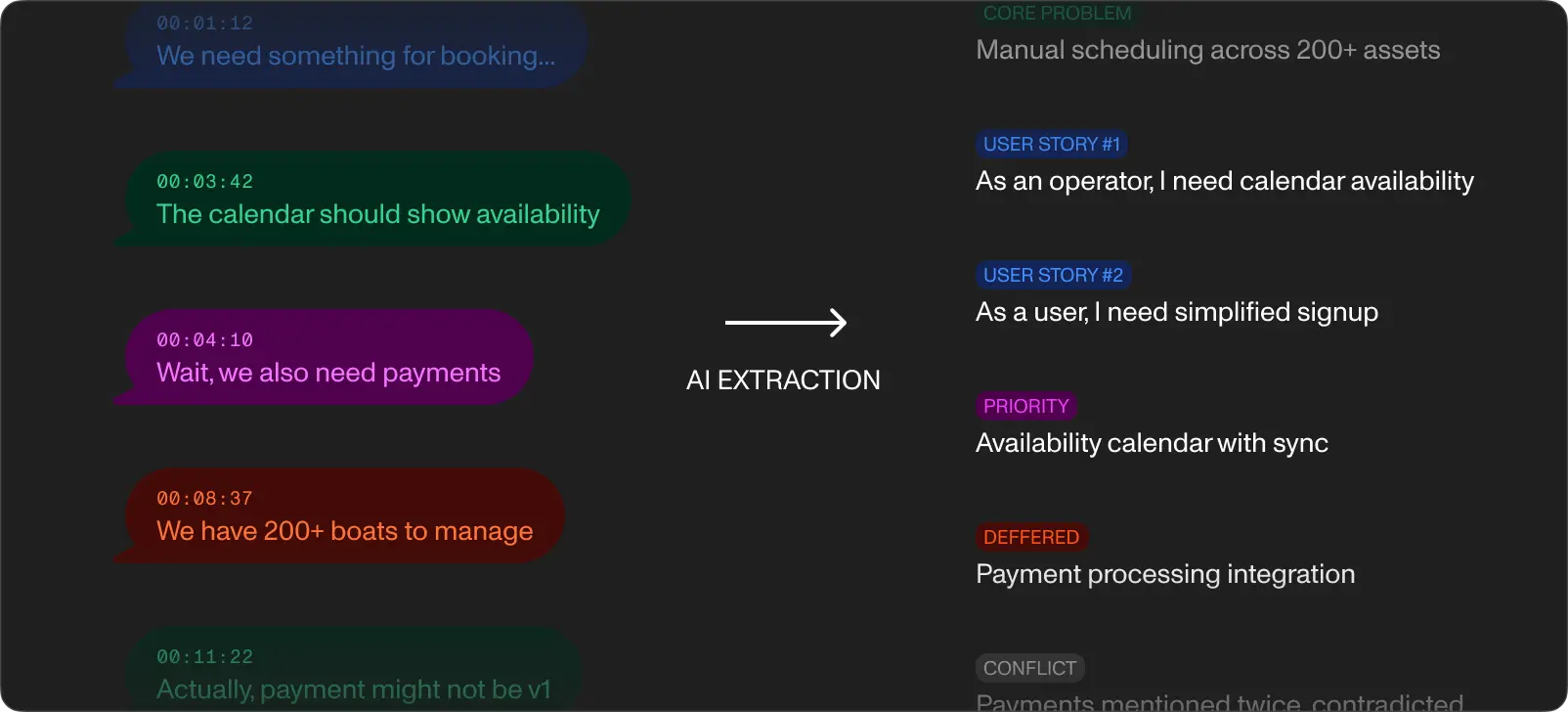
The first meeting is the most important input to the entire sprint. We record it. We transcribe it. Then we feed the transcript into AI to extract requirements, identify priorities, and surface contradictions.
This sounds like a small detail, but it changes everything. In a traditional discovery process, a founder talks for an hour. Someone takes notes. The notes miss context, emphasis, and the offhand comment where the real insight lived. Two weeks later, the team builds something based on a summary of a summary.
Our approach is different. The full conversation becomes a searchable, structured document. AI pulls out the user problems, the feature requests, the edge cases, and the places where the founder said two contradictory things without realizing it. We catch those contradictions in hour one, not in month three after the wrong thing got built.
Stage 2: Product requirements document
We use the discovery transcript to generate a structured PRD with user stories, user flows, and screen-level detail. The team reviews and corrects it before anything gets built.
In a traditional setup, writing a solid PRD takes one to three weeks. Meetings, revisions, more meetings. With AI processing the raw transcript, we produce a first draft within hours. The team then spends time on what humans do best: questioning assumptions, adjusting priorities, and making judgment calls about scope.
This step replaces weeks of back-and-forth with a focused review session. The document is not perfect on the first pass. It does not need to be. It needs to be good enough to build from, and good enough to argue over. Both of those happen faster when you start from a structured draft instead of a blank page.
Stage 3: Implementation plan
Requirements go into our AI-assisted development environment. We break the build into executable steps and review scope before touching code.
This is the checkpoint where we make sure what we promised to build maps to what you need. Founders often describe a product in terms of features. We translate features into buildable components, estimate effort, and flag where scope needs trimming to stay within the sprint timeline.
The implementation plan is also where we decide what gets built first. In a five-day sprint, you do not build everything. You build the thing proving the core assumption. If the prototype validates the central idea, everything else becomes a detail. If it does not, you found out in a week instead of a quarter.
Stage 4: Prototype build and iteration
We build in short loops. Each loop produces something testable. We adjust in real time based on what works in the actual interactions, not based on what looked good in a document.
This is where the speed shows up. A traditional agency takes weeks to deliver a first build. In our sprints, the first testable version appears within the first couple of days. From there, we iterate. You see it. You react. We adjust. The prototype improves with every cycle.
AI assists here in code generation, component scaffolding, and documentation. The product decisions, the interaction patterns, and the scope calls stay with the team. The result is a better prototype delivered faster, because the humans spend their time on judgment and refinement instead of boilerplate.
Three sprint formats
Not every founder needs the same thing. Some need direction. Some need something to show an investor. Some need a working proof of concept for user testing. We shape the sprint around the goal.
AI Discovery Sprint
For founders who have an idea but no product direction yet. The goal: turn uncertainty into a testable concept with wireframes, user flows, and a feasibility check. Delivered in under a week.
This is the format for early-stage founders who are still figuring out what to build. They know the problem. They have a sense of the solution. But the product shape is unclear. A AI Discovery Sprint takes the idea through discovery, structures it into a product concept, and produces enough clarity to decide whether to move forward, pivot, or stop.
The output is not code. It is a clear concept with enough detail for the next conversation, whether with a technical co-founder, an investor, or a development team.
Pitch-Ready Prototype
For founders preparing to raise. The goal: a working AI-driven prototype polished enough to present in a room. Focuses on the core value proposition, not full feature coverage. Includes narrative framing for the pitch context.
This is the format founders ask for most often. They have a fundraise coming up. They need something investors interact with, not another deck to click through. The Pitch-Ready Prototype builds the one flow demonstrating why this product matters and how it works. It does not cover every edge case. It covers the core story.
Investors react to something they touch differently than something they read. A working demo turns a pitch meeting from "here is what we plan to build" into "here is what we built." The conversion rate on those two conversations is not the same.
AI Proof of Concept
For teams with a defined problem who need a working proof of concept to validate assumptions with real users. Functional, interactive, and built to collect genuine feedback.
The AI Proof of Concept is the most technical of the three formats. It produces a working proof of concept users interact with. The goal is not polish. The goal is learning. Does the core flow work? Do users understand it without explanation? Where do they get stuck? What do they try to do first?
This feedback is more reliable than any amount of requirements gathering. People know what they want when they see something they do not want. An AI Proof of Concept surfaces those reactions in days instead of months.
One thing applies to all three formats: the output of every sprint feeds directly into an AI proof of concept or AI MVP if you decide to move forward. There is no gap between prototyping and full-scale development. The PRD, the implementation plan, and the prototype code all carry forward. Nothing gets thrown away and rebuilt from scratch.
Why this approach works
The benefits of AI-driven prototyping come down to three business-level arguments.
Validation before investment
The biggest risk in software is building the wrong thing. A full development cycle costs tens of thousands, often hundreds of thousands, and takes months. A one-week sprint costs a fraction of this. And the feedback from a real prototype is more reliable than any amount of planning.
We see this pattern with our clients constantly. The thing the founder was most excited about is not what users respond to. The feature nobody prioritized ends up being the one creating engagement. A prototype surfaces these insights early, before the budget is committed and the architecture is set.
The principle is straightforward: test the assumption before you invest in the assumption. A one-week sprint is the cheapest way to find out if your idea works, or if it needs to change direction.
Demo-ready from day one
For founders in fundraising mode, a working prototype changes the conversation. Investors see hundreds of decks. They remember the ones where they touched the product.
Speed to prototype is speed to a decision. If you are raising in Q2, and your prototype is ready in Q1 instead of Q3, your entire fundraising timeline shifts. You enter conversations with proof, not promises. And the follow-up conversations start from "when" instead of "if."
AI compresses the process, not the thinking
We are direct about what AI does and does not do in our sprints.
AI accelerates documentation. It processes transcripts, generates PRD drafts, scaffolds code, and handles repetitive structural work. This saves days of manual effort on every sprint.
AI does not make product decisions. The judgment calls, the scope decisions, the instinct about what to build first and what to cut: those come from the team. From founders who know their market. From designers who understand user behavior. From engineers who know what is buildable in the time available.
The result is a better prototype delivered faster. Not a shortcut to a mediocre one.
One more thing worth noting: a sprint surfaces critical questions early, before you commit resources to a full build. Even if the prototype reveals the idea needs significant rethinking, the cost of learning is one week and a small budget. Compare the cost of learning the same lesson six months and six figures into development.
Some of our biggest products started as prototyping sprints. Serwizz, our CMMS platform for service and maintenance teams, began as a focused proof of concept before becoming a full SaaS product. The Capax service report app followed the same path: sprint, validate, then build. When the prototype works, the transition to a full product is seamless because the groundwork is already done. We wrote about this broader approach to AI-driven digital transformation in a recent post.
What comes next
If you have an idea and no prototype, you are guessing. AI-driven prototyping closes the gap between "we think this will work" and "we know this works" in a matter of days.
At Workspace, we run AI Discovery Sprints, Pitch-Ready Prototypes, and AI Proof of Concept for founders and product teams who need speed and clarity. The discovery, the PRD, the build, and the iterations all happen in one compressed sprint, powered by AI and guided by human judgment.
If you are sitting on an idea, preparing for a raise, or trying to validate a concept before committing to a full build, a conversation about where to start is a good next step. Reach out to book a discovery session.