
Now that the dust has settled after Google I/O 2026, here's what it boils down to: Google's building a layer of AI agents that sits between people and the web, doing more and more of the work your customers used to do themselves, and turning your website into something the agent reads on their behalf rather than somewhere they go.

For any business owner who's been hearing for the last year or so that AI is killing the click and the marketing playbook is shifting under them, the obvious question is whether spending money on a website in 2026 still makes any sense at all. The anwser is yes, but the case for one has shifted in ways that matter for what you should actually be building.
What Google showed at I/O
Take the announcements as a whole and Google's intent is pretty clear: build a layer where the agent does the searching, comparing, watching, and increasingly the buying, while your website turns into a structured source of information the agent reads to make those calls on the customer's behalf.
Search is where most of this becomes visible first. Google announced Search agents that you create inside Search and leave running continuously, monitoring whatever you've asked them to watch and pushing back updates when something matches. The demos showed one watching biotech stocks against specific financial criteria, another tracking sneaker drops across blogs and the Shopping Graph for athlete collabs. The user in those scenarios never opens a finance site or a sneaker blog, the agent reads them on a schedule and synthesizes what matters. Search also got generative UI, which means the AI Overview now builds interactive tools on the fly inside the result itself. A question about gravitational waves got an interactive simulator with adjustable parameters built in seconds, with no link out to a third-party explainer needed.
Shopping got three protocols at once. Universal Commerce Protocol (UCP) standardises how agents talk to retailers and shipped with Amazon, Meta, Microsoft, Salesforce, and Stripe as founding partners, which is the kind of lineup that turns a proposal into industry infrastructure quickly. Agent Payments Protocol (AP2) lets an agent transact on the customer's behalf within rules they've set in advance, like a price ceiling or a list of approved brands. Universal Cart is the cart Google wants to live across Search, Gmail, YouTube, and Gemini all at once, watching prices, monitoring restocks, and reasoning about what's actually in it: the keynote demo caught a CPU and motherboard with mismatched sockets before the customer checked out, and it's the cleanest single example of what this layer is supposed to do.
WebMCP sits underneath all of this. It's a proposed browser standard that lets a website expose its functionality directly to agents rather than having the agent scrape the page and guess what it does. Your site tells the agent explicitly what you sell, how to book, how to check stock, what your hours are. Google described it as making a site "agent-ready in minutes", which is marketing language, but the underlying idea points exactly where the rest of the announcements were pointing: websites get a real protocol for being read by machines.
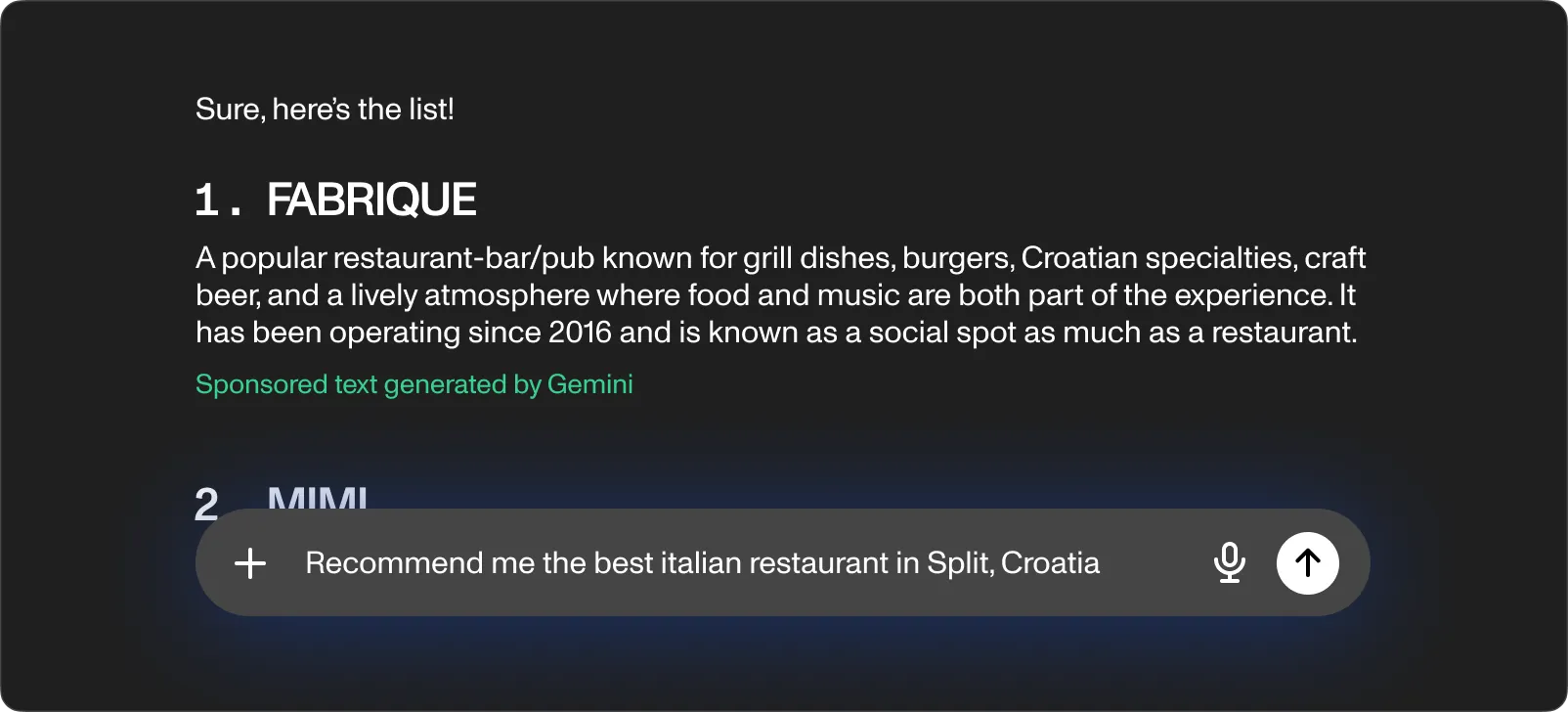
Conversational ads, announced at Google Marketing Live the next day, are the new ad format inside this layer. They're generated by Gemini as part of the AI response itself, with the advertiser handing creative and targeting control to Google's systems, and the brand appearing inside the answer rather than on a banner the customer might or might not click.
Spark in Chrome closes the loop. Spark is Gemini's autonomous agent, and later this summer it'll run inside Chrome and navigate arbitrary websites on the customer's behalf, which means even the tasks that still require visiting a specific site today, like checking a bank balance or booking a service, can be handled in the background without the customer ever opening the page.
What this looks like from the customer's side
Map all of this back to how a customer actually finds and buys something and the shape of the journey changes pretty significantly. The journey from "I want something" to "I've bought it" used to run through a search results page, a couple of website visits to compare options, a product page, and a checkout flow on whichever site won the click. In the new shape, the customer asks, the agent reads the relevant parts of the web, synthesizes a recommendation, and either hands them a Universal Cart with the right product already in it or sets up a Search agent that watches in the background until something matches.
The Universal Cart demo is the clearest concrete version of this. The customer wanted to build a new PC, added components from across different retailer surfaces, and would've completed an incompatible purchase because the CPU and motherboard sockets didn't match. They didn't open the manufacturer's product page or read the spec sheet themselves, and the cart caught the mismatch because it could reason about the specs on the product pages on the customer's behalf. The role the customer played shrank from researcher-and-comparer to instruction-giver, and what used to be four or five website visits collapsed into a single interaction with the agent.
The "websites are dead" thought starts here and on the surface it's understandable enough: if your customer doesn't visit your site, they don't see your business.
The framing is wrong though. The agent in the loop has to read something to make any recommendation, which means the answer it eventually gives the customer is being built from sources somewhere on the web. If your business isn't legible to the layer doing the synthesizing, the agent doesn't include you when it builds that answer, and your absence is invisible to the customer because they only see what the agent surfaces.
So do you still need a website?
Yes. When an AI agent decides what to recommend, where to send a Universal Cart, what to put in a synthesized answer, or what to surface in a Search agent update, it needs to read information about your business from somewhere, and that somewhere is your website. It's the one place where what you do, who you serve, what you charge, and how you deliver is laid out in a single canonical form that you control. Social profiles, Google Business listings, third-party reviews, and your ads are all either downstream of your site or only show a sliver of the business, and none of them give an agent the same complete picture.
WebMCP is essentially Google formalising this role: it's a protocol for handing your site's capabilities to agents directly. The underlying logic was already true before WebMCP and stays true even if the standard itself takes years to be widely adopted. The agent reads something to make any decision about you, and your site is what it reads.
What this changes is the cost of not having a real site. For most of the last decade, that cost was lost SEO and reduced organic traffic, which was painful but absorbable for businesses with strong word of mouth or paid acquisition channels. The agent layer is a different kind of cost: when more of discovery and purchasing happens inside it, your absence from it means your business doesn't appear in the answer the customer sees, and there's no scroll-further-down option that bails you out.
What an agent-ready website looks like
Agents read your site the way a careful human reader would, looking for clear information about what you do and getting impatient when they have to wade through marketing copy to find it. The site that performs well in this environment is one where the substance is laid out clearly and structured well enough that a machine can parse it without having to interpret stylistic prose.
In practice that means real depth on every product or service page, the kind that says what the thing is, who it's for, what it costs, what's included and what isn't, and the trade-offs that actually matter to a buyer making a decision. The markup needs to be semantic enough that the agent isn't guessing what's a price and what's a heading, and the content needs to answer the questions buyers actually ask rather than chase keywords. The Universal Cart catching the CPU and motherboard mismatch worked because the manufacturer's product page had a properly structured spec sheet that named the socket type explicitly, and if that same information had lived only in a marketing PDF, a paragraph of body copy, or a printed brochure, the agent would've had nothing usable to work with and the incompatible purchase would've gone through.
Almost everything that makes a site good for a careful human reader also makes it good for an agent, but the bar on what good means just went up.
The kind of site that doesn't make the cut
What this means in practice is that a lot of the cheap, fast websites that get sold to small businesses don't really work in this environment. A site that's mostly a hero image, a tagline, three vague service cards, and a contact form just doesn't give an agent anything substantive to read about what you actually do, and a template build with stock photos and an About page filled in with copy that could apply to any business in your industry has the same underlying problem. The site reads fine, but there's no real material in it for an agent to ground a recommendation on.
A site like that might still look perfectly fine to a human visitor who lands on it from a Google Ad, but the question is no longer whether it looks fine to a human visitor, because increasingly that visit isn't going to happen.
A site that works in this environment is one where the substance of the business is in the foreground, with real depth about what you offer, who it's for, and what it costs, and where the design supports that substance rather than hiding it under a layer of style. The visual design still matters because humans still see it, but the underlying content is doing more of the work now than it was even two years ago.
Where we come in
At Workspace we spend a lot of our time thinking about this kind of problem, how to build websites where the substance comes through clearly to everyone reading them, agents and humans both. If you've been holding off on building a real site because you weren't sure it was worth the investment any more, the math has shifted enough that it might be worth a conversation. Reach out if you want to talk it through.