
On May 13, 2026, Wix reported first quarter revenue of $541.2 million, up 14% year over year. Bookings grew 15%. Bookings from new user cohorts grew 46%. The stock fell 27% the same day, from $75.88 to a close near $55, erasing roughly $860 million of market value.
Fifteen days later the company cut roughly 1,000 people, about 20% of its workforce. Eleven days later, it lowered full year guidance. By late July a securities class action had been filed in the Northern District of Illinois. The headlines converged on one explanation: AI came for the website builder, and the website builder went down.
The Wix collapse of 2026 has a more specific cause than AI, and the filings say so plainly.
Wix's own AI product is one of the fastest scaling assets in its category. Its share of the CMS market went up during the collapse, not down. What broke was the margin structure, and it broke for reasons with names and dollar amounts attached: roughly $90 million of customer acquisition spend in a single quarter, two Super Bowl spots, an acquisition earnout paid in cash, and a shekel appreciating more than 20% against an Israeli cost base.
This post covers what happened between January and August 2026, separates the AI narrative from the accounting, and looks at whether AI site builders make development teams irrelevant. On the last question the evidence is unambiguous, and it points the other way.
All figures below reflect public data as of August 3, 2026. Wix reports second quarter results on August 4.
How a 14% growth quarter became a 27% drop
Twenty years of getting it right
Three founders started Wix in Tel Aviv in 2006: Avishai Abrahami, Nadav Abrahami, and Giora Kaplan. The first product ran on Adobe Flash, which looked reasonable in 2007 and looked terminal three years later after Apple refused to support it on iOS. Wix shipped an HTML5 builder in March 2012 and moved its base across.
Wix priced its IPO on November 5, 2013 at $16.50 a share, valuing the company near $800 million and raising $127 million. It then bought attention at scale: five consecutive Super Bowl campaigns from 2015 to 2019, celebrity spots, and a marketing line running above half of collections at its peak. The share price closed at an all time high of $353.09 on February 19, 2021.
The company also picked fights. In 2016 Matt Mullenweg accused Wix of shipping GPL licensed WordPress code inside its iOS editor, down to the icons and the bugs. In December 2020 Wix mailed Bose headphones to prominent WordPress developers, Wes Bos among them, who posted the unboxings in confusion. Four months later came video ads casting WordPress users as therapy patients traumatized by updates. Mullenweg answered with the line the developer community kept: if website builders are compared to abusive relationships, Wix is the one locking you in the basement, since it offered no content export at all.
Then came the discipline phase. Wix announced a $150 million cost reduction plan in August 2022. A month later Starboard Value disclosed a 9% stake and argued spending had outrun growth anyway. Its sharpest number: marketing headcount tripled between 2018 and 2021 while revenue grew 2.1 times. A $300 million buyback followed in October. It worked. Full year 2025 closed with $1.99 billion in revenue, $573 million in free cash flow, and a 30% free cash flow margin excluding acquisition costs.
Wix spent 2025 winning the argument Starboard started. It spent the first quarter of 2026 spending the winnings.
The AI pivot: Base44 and Harmony
On June 18, 2025, Wix paid $80 million in cash for Base44, a six month old vibe coding platform built by Maor Shlomo, a solo founder in Israel. Base44 turns a text prompt into a working app with database, auth, storage, and integrations attached. At acquisition it had 250,000 users, eight employees, and $189,000 of monthly profit. Roughly $25 million of the price went to retaining those eight people, with performance earnouts running to 2029 on top.
It was a good buy. Base44 annual recurring revenue went from about $50 million in late 2025 to $100 million in March 2026 to $150 million by mid May, having passed 2 million users back in November 2025. For $80 million, Wix acquired the fastest growing product it owns.
On January 21, 2026, Wix launched Harmony, an AI website builder pairing natural language prompts with traditional drag and drop, driven by an agent called Aria. By the first quarter Harmony ran on a proprietary model Wix built in house.
Professional users were less enthusiastic than the launch materials. On Wix's own Studio forum, the recurring complaints are workflow-breaking rather than cosmetic. Harmony shipped without Share for Review, so an agency builds a site the client has no way to see before it goes live. One user described building a site under exactly those conditions and called it a huge oversight. Another flagged feature regression against the Classic Editor and wrote the AI "does not perform as requested VERY often", adding it "feels more like a test-version". Button hover styling supports a single color. The Add Elements panel drew complaints for being unpleasant to use.
Wix management said versions of the same thing on the earnings call. Harmony has holes. Some partners, in Zohar's phrasing, "are using some AI platforms." Product updates had slipped. The sharper reading, where professional developers defected outright, comes from the plaintiffs' filings rather than from Wix.
The quarter where the math broke
Here is the first quarter of 2026 next to the first quarter of 2025.
| Metric | Q1 2026 | Q1 2025 |
|---|---|---|
| Revenue | $541.2M | $473.7M |
| Bookings | $585.0M | $510.9M |
| Sales and marketing | $199.6M | $111.6M |
| Research and development | $178.2M | $127.5M |
| Non-GAAP operating margin | 5% | 21% |
| GAAP diluted EPS | -$1.02 | +$0.57 |
| Free cash flow | $75.0M | $142.4M |
Revenue and bookings both beat the prior year comfortably. Everything below the top line went sideways. Total GAAP operating expenses rose 48.7%. Sales and marketing rose 79%. Operating margin fell 16 points in twelve months.
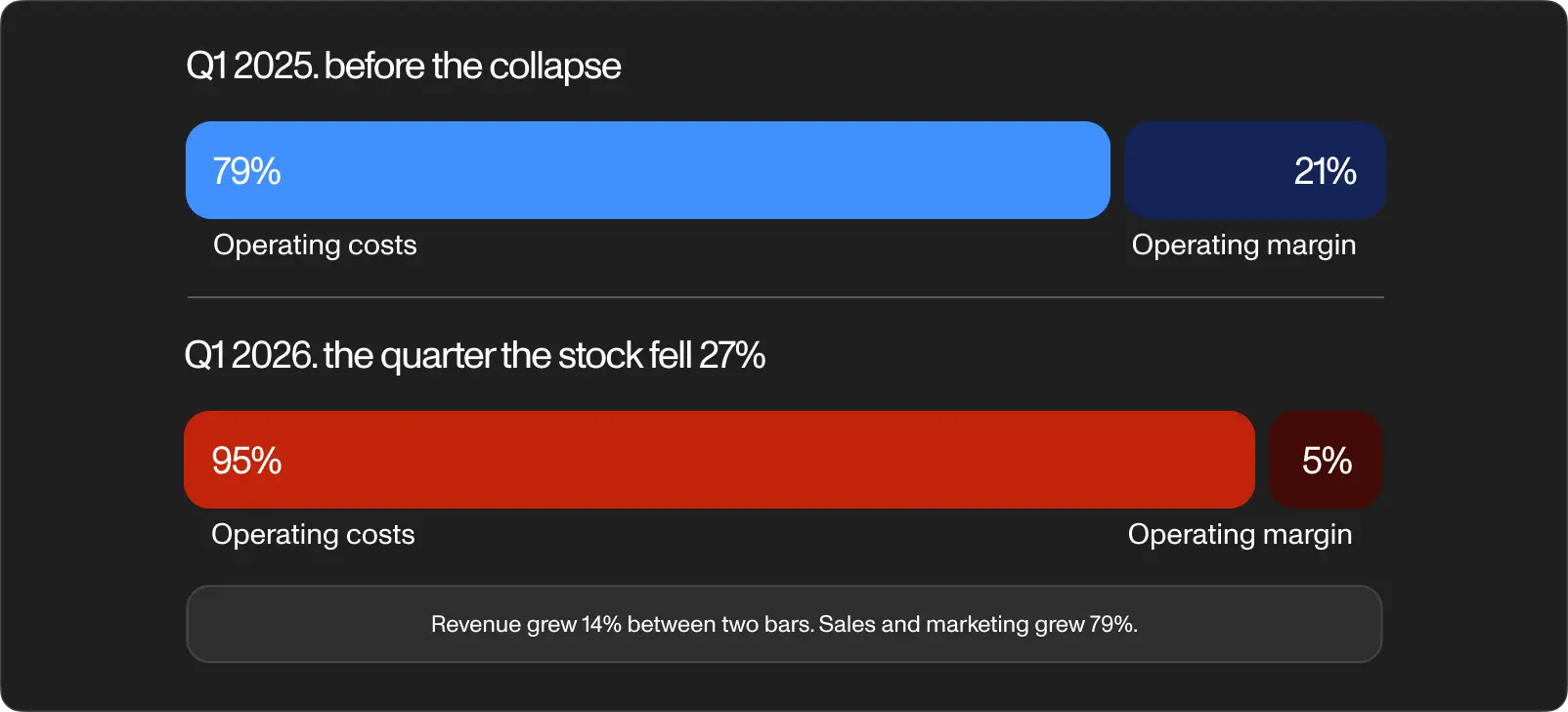
Wix deployed around $90 million in acquisition marketing for Base44 and core Wix in one quarter. Zohar was specific on the call: the $90 million excludes Super Bowl expenses and the AI costs of free users. Super Bowl LX carried two Wix spots, one for Harmony and one for Base44, reported above $20 million and put at roughly $24 million on the call. It also finished a $1.617 billion Dutch auction tender in April, buying back 17.5 million shares at $92 and retiring roughly 30% of the float, partly funded by a $500 million credit facility. Interest income went away and interest expense arrived.
The AI compute story is the interesting part, because Wix argued against it. CFO Lior Shemesh attributed gross margin pressure to investment in Base44 growth and described AI expense as front loaded, since new users burn the most inference while building. President Nir Zohar called the proprietary Harmony model investment quite small and said it should carry no real weight on expenses.
Two more items nobody outside Israel priced in. First, more than 60% of Wix staff sit in Israel, and Zohar told analysts the team had taken a productivity headwind over the preceding months. Second, the shekel appreciated hard against the dollar, a roughly $64 million full year expense headwind for a company earning in dollars and paying in shekels.
Then came the sequence. May 28: about 1,000 roles cut, 20% of a 5,277 person company, $30 to $35 million in restructuring charges, $150 million of annualized savings. Abrahami told staff it was a sad day and told Israeli press a meaningful portion of costs sit in shekels while revenue sits in dollars. June 8: a 6-K cutting bookings growth guidance from mid teens to low teens, blamed on discontinued initiatives and a slowdown in the Partners business, the agency and freelancer channel worth 38% of revenue. Note what the same filing did with cash: free cash flow guidance went up $20 million to about $420 million. A company drowning in AI compute bills does not raise its cash guidance in the same breath. The stock closed down 8% at $48.21 and kept sliding to $42.64 by June 17.
By August 3, 2026, Wix trades at $55.03 with a $2.30 billion market cap, down 84% from the 2021 peak, 47% year to date, and 71% off a 52 week high of $190.93 against a low of $40.16. Morgan Stanley moved to Equalweight on July 21 and cut its target from $112 to $60. Consensus across 22 analysts still reads Buy at $72.20.
The class action, filed as Yappi v. Wix.com Ltd. in the Northern District of Illinois, covers a class period of February 19, 2025 to May 12, 2026. The core allegation: Wix overstated how Base44 and Harmony performed against rivals while understating the cost of building and promoting them. Lead plaintiff applications close September 22, 2026. These are allegations. No court has ruled on them.
What the evidence says about AI built sites
The comfortable reading of the Wix story is generational: AI builders arrived, professional web work evaporated, and a public company got caught in the transition. Fortune ran a piece on May 31 pushing back on the broader version of this. Paul Osterman of MIT Sloan put it directly, calling AI a perfect excuse to justify big layoffs because it makes the decision look external. Fortune's supporting example is Cisco, whose stock rose 13% on the day it announced 4,000 cuts, though the same session brought $5.3 billion of AI orders, so the market had two things to react to. The incentive to attach the AI label to a restructuring is real either way.
Wix is close to a textbook case. Abrahami's primary stated reason to Israeli media was currency. The June 6-K blamed discontinued initiatives and channel weakness. The AI framing sat on top of both.
The sector data does not support a collapse either. Shopify grew revenue 34% in the first quarter of 2026 to $3.17 billion on $100.7 billion of GMV. GoDaddy's Airo AI bookings hit a $50 million run rate, up 5 times in a single quarter. In the W3Techs CMS rankings, WordPress slid from 43.20% in December 2025 to 41.90% in May 2026 while Wix ticked up to 4.30% and Shopify and Squarespace both gained. Worth noting most of the WordPress loss went to sites running no detectable CMS at all, not to Wix. Wix's user base grew through the entire episode. Its stock, margin, and credibility fell.
AI generated code did not get safer
Veracode's GenAI Code Security Report is the most useful dataset here because it is longitudinal. Across 80 coding tasks in 4 languages and more than 150 models, 44% of AI generated code contains a known security vulnerability when the prompt includes no security guidance, per the edition published on July 28, 2026. The spring edition put it at 45%. Syntactic correctness passed 95%. The security number has moved about one point in two years.
The failure modes are uneven. In the spring dataset, models handle SQL injection at an 82% pass rate and insecure cryptography at 86%. Cross site scripting passes 15% of the time. Log injection passes 13%. By language, Python reaches 62% and Java reaches 29%.
Here is the shape of it in practice, from an ordinary prompt asking for a comment box:
import { sanitize } from 'html-sanitizer-pro';

export function renderComment(userInput) {
  const box = document.getElementById('comment');
  box.innerHTML = userInput;
}
Two problems in six lines. The package on line 1 has no existence on npm, one of the roughly 20% of AI imports with no package behind them. Line 5 writes user input straight into innerHTML, the cross site scripting case models get right 15% of the time. The sanitizer imported at the top never gets called. Both lines compile, run, and ship.
Enterprise telemetry says the same thing at scale. Apiiro found developers using AI assistants commit at 3 to 4 times the rate of their peers, with security findings rising roughly tenfold, privilege escalation paths up 322%, and architectural design flaws up 153%. Georgia Tech's tracking of CVEs attributable to AI generated code counted 6 in January 2026, 15 in February, and 35 in March.
One number deserves its own sentence: about 20% of AI generated code samples reference packages with no existence, and 43% of those hallucinated names repeat across similar prompts. Attackers register the names. We wrote about how npm supply chain attacks work in 2026 and hallucinated dependencies are the newest delivery route into it.
Meanwhile about 80% of developers surveyed believe AI writes more secure code than humans do.
The maintainability gap
GitClear analyzed 623 million changed lines between 2023 and 2026. Duplicated code blocks rose 81% against the 2023 baseline, from 40.3 to 73 blocks per million changed lines. Copy and paste reached 15.7% of changed lines in the first half of 2026, up from 9.4% in 2022. Error masking constructs rose 47%.
The number worth remembering is moved code, the signal for refactoring. It fell from 21% of changes in 2022 to 3.8% in 2026. Four years ago developers refactored at twice the rate they copied. Now they copy at four times the rate they refactor.
Google's DORA 2025 report, covering roughly 5,000 professionals, found 90% using AI at work and 30% reporting little or no trust in what it produces. AI use correlates positively with throughput and negatively with delivery stability. The report's summary of its own findings is worth keeping: AI does not fix a team, it amplifies what the team already does.
Where AI builders fit, and where they stop
None of this makes AI builders useless. It makes them a phase of work rather than the whole of it.
Prototypes and validation. Base44, Lovable, Bolt, and v0 turn an idea into something clickable in an afternoon. For testing a concept with real users before committing budget, nothing beats the speed. We covered the practical version of this in AI driven prototyping from idea to working product in days.
Production is a different job. The gap between a working demo and a system handling payments, personal data, and traffic is where these tools consistently break. Lovable shipped CVE-2025-48757, a row level security misconfiguration exposing 170+ apps and 303 endpoints containing emails, home addresses, payment status, and personal debt figures. Its first fix checked whether a security policy existed rather than whether the policy blocked anything. Escape.tech's audit of vibe coded apps counted 2,038 critical vulnerabilities, more than 400 leaked secrets, and 175 instances of exposed personal data including bank details. Our post on taking vibe coding from prototype to production covers the handover in detail.
Churn is the sector's open secret. Barclays tracked traffic to the major AI builders through September 2025 and found Lovable down 40%, v0 down 64%, and Bolt down 27% from their peaks. Bolt CEO Eric Simons said it out loud: "The churn rate for everyone is really high. You have to build a retentive business." Users arrive to build, then leave when the thing needs securing, debugging, and scaling.
Visibility is its own problem. A site generated in an afternoon tends to carry generated content, and AI search engines are selective about what they cite. Editorial depth outperforms commercial template pages by a wide margin in citation studies. We wrote about the mechanics in why AI search engines cannot find you.
Every launch keynote carries the same claim, where professional builders become unnecessary. Retire it. What changed is where the work sits. Less time typing boilerplate, more time on architecture, security review, data modeling, and the integration surface where AI output consistently fails. We made a version of this argument last year in once again, designers are dead, and the same pattern showed up in the Tailwind CSS crisis of 2026, where AI adoption gutted a tool's business model while adoption of the tool itself hit record highs. Usage and value stopped moving together.
Before you pick a builder
Four things settle most of this before a line of code exists. None of them is about speed.
The export path
Ask for it in writing, not from the marketing page. Wix offered no content export at all while running ads attacking WordPress over lock-in, and the developer community noticed. WordPress, Shopify, and any custom stack hand you the files and the database. An AI builder often hands you a hosted account and a subscription.
The rule no model writes
Every project reaches one. A partial API response at 04:00. A payment schedule spanning a season boundary. A cancellation tier keyed to a date range. Someone writes it, and the name of the person writing it is worth knowing before the rule is needed.
The security review
44% of AI generated code carries a known vulnerability and 80% of developers believe the opposite. Name the person reading the output. If the generator reviews itself, there is no review. We set out what the finished state looks like on one stack in what a secure WordPress site looks like.
Year three
The person who wrote the prompt has moved on and the upstream API changed its response shape without telling anyone. Someone maintains the thing. The cost shows up whether or not it was budgeted.
For a brochure site with a small content team, a builder is a reasonable answer and so is WordPress, and the choice comes down to who maintains it and how the content gets out. For anything carrying payments, personal data, or a feed from a system you do not control, the generated first version is a starting point rather than a delivery. We work mostly in the second category: booking flows, service reports, upstream feeds breaking at inconvenient hours. The work is boring to describe and expensive to skip.
If you are sitting on a prototype with real customers on it, reach out to book a discovery session. We go through which parts hold, which parts need rebuilding, and what the second version costs before it breaks on its own schedule.