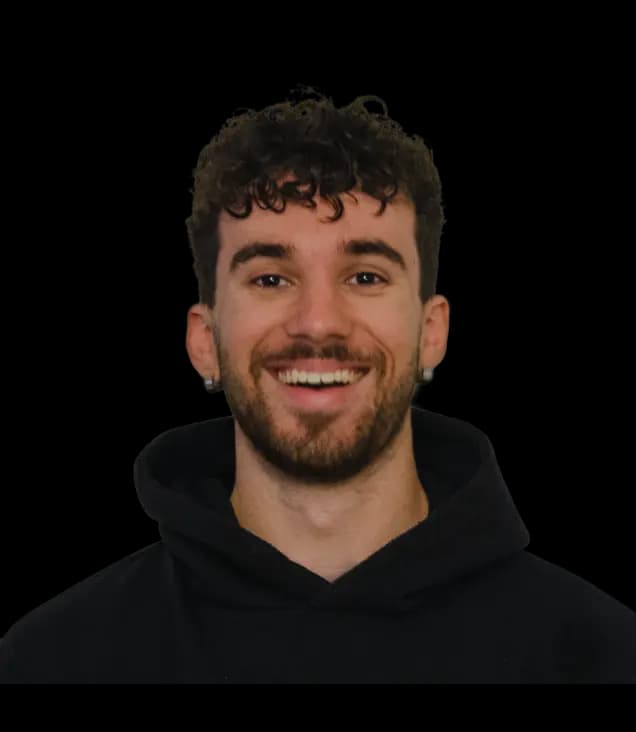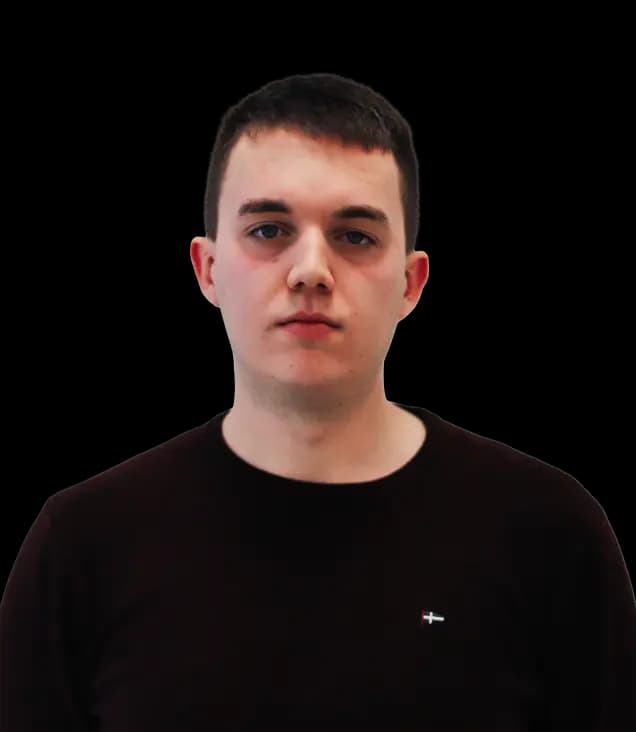
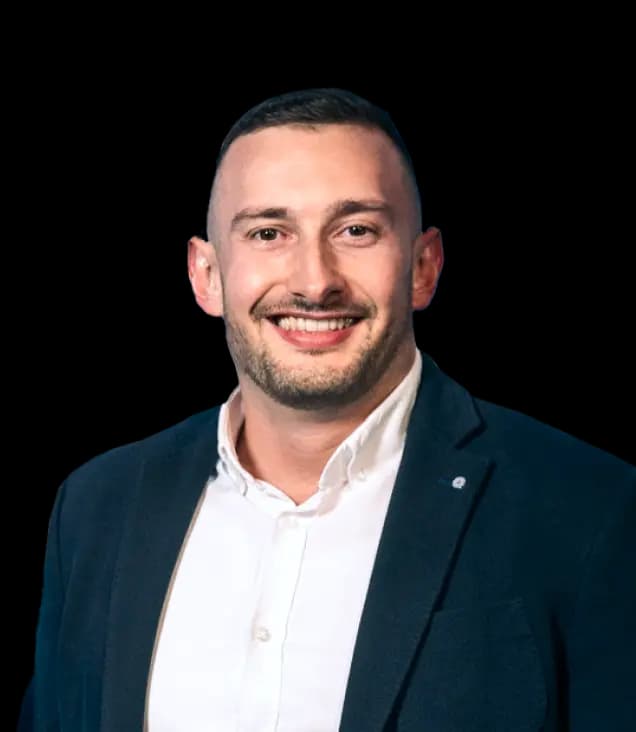
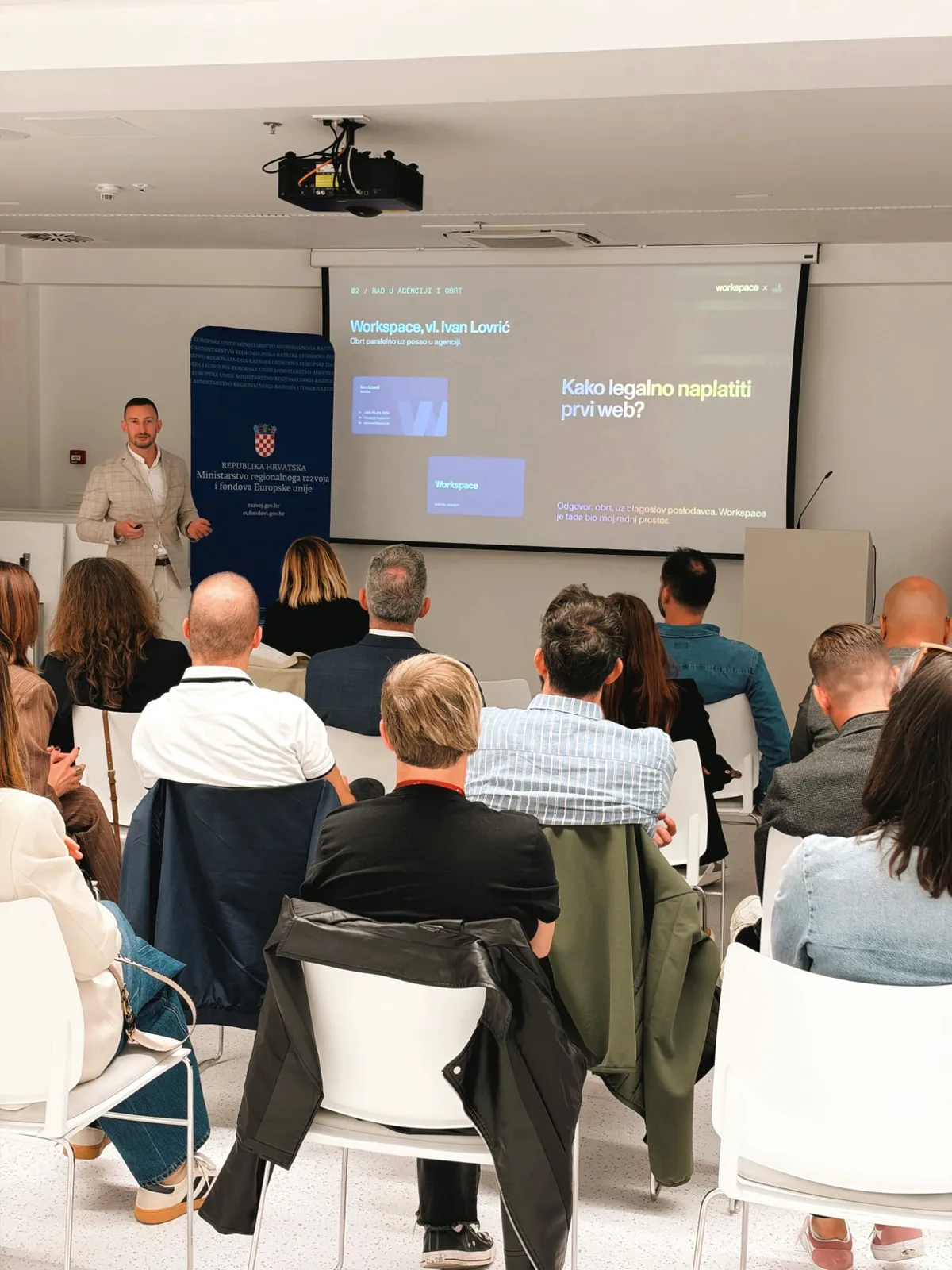
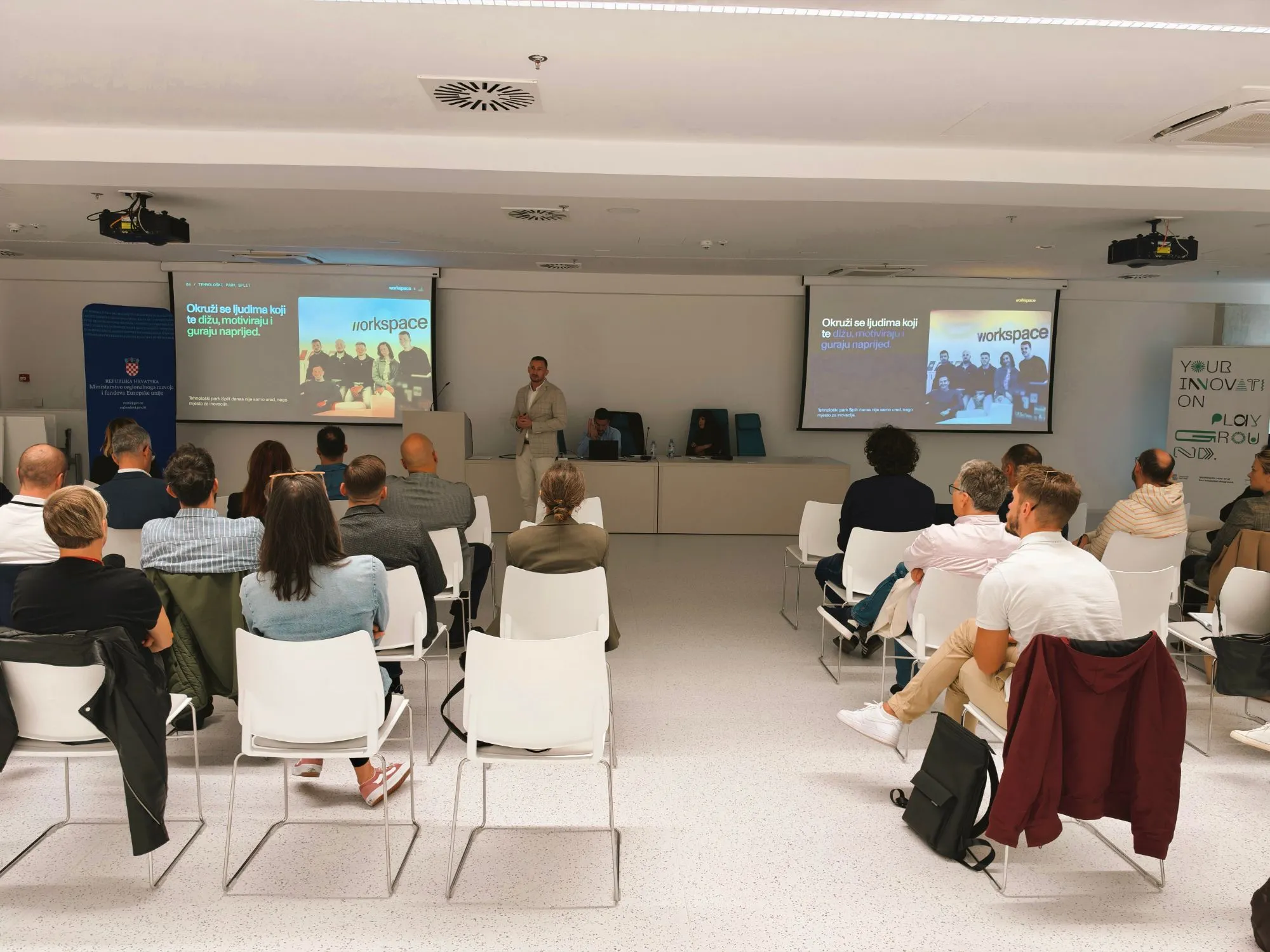
On October 15, 2026, I spoke at Tehnološki park Split during the workshop "Development of entrepreneurial infrastructure on islands", organised by Croatia's Ministry of Regional Development and EU Funds and JASPERS, about my business path and what it's like to run a company inside the Park. The audience was ministry teams, local governments and consultants preparing business support infrastructure for Croatian islands, so they wanted one tenant's view, and preparing 20 minutes of slides showed me my own story had never been written down in one place, which is why this post exists.
Workspace is a custom software company from Split, Croatia, which I started in 2020 as a flat-rate sole proprietorship (paušalni obrt) next to a full-time job, turned into Workspace d.o.o. in August 2023 and moved into Tehnološki park Split in September 2024 as one of its first tenants. Serwizz is a CMMS (computerized maintenance management system) for service and maintenance teams, built from a problem we kept finding at our clients, and I co-founded it with Josip Brčić.
My first clients paid in coffee
Everything started at III. gimnazija Split, the school everyone in Split calls MIOC, where an informatics class showed me how a web page gets built. Those pages were primitive, plain HTML, CSS and JavaScript, but I fell for it right away and kept building small projects for fun, and soon classmates were asking me to make their homework projects in exchange for coffee or marenda, the Dalmatian mid-morning snack.
For a high school kid it was a great deal, because I'd turned something creative into work somebody was willing to pay for.
A year in a corporation and a decision on the Canary Islands
As a student I got the chance to work almost full-time for a large corporation in software and telecommunications. I spent a year there on modern web technologies and learned a lot about how a big team runs and what it means to be one small part of a corporation.
I left the job for Erasmus on the Canary Islands, where I lived the best days of my life, learned Spanish, wrote my thesis and had plenty of time to think, because I was about to graduate and my first real job was waiting. On those islands I decided I didn't want to do a bit of everything, I didn't want to go back to telecommunications or to any other field I didn't care about, and I wanted to become an expert in web technologies.
I had no idea back then what being an entrepreneur meant, but I knew I wanted the freedom to choose: to do work I love, with people who love it as much as I do. Looking back, I see it as the first spark of what I do today.
Why I spent six years in an agency first
When I came back to Split, the corporation had closed my team, and I had no wish to pivot into telecom. The decision from the Canaries was even stronger by then, and I wanted to build my expertise in a smaller company, where I'd see the processes up close, where the bar would be higher, where it's obvious who works and who coasts, and where I'd work on the newest web tech.
I applied for an open frontend developer position at a digital agency, did the interview, got a test task, solved it, and the rest is history. I stayed for more than 6 years, and besides development I led HR and became part of the core team, so I watched up close how a digital agency runs.
How Workspace started as an obrt in 2020
Early in 2020, right before Covid, the first requests for websites started reaching me on the side, and my first problem was practical: how do I invoice this legally and get paid? With my employer's blessing I opened an obrt and called it Workspace, the same name the company carries today, because back then it was exactly what the name says, my own workspace.
From day one I wanted it to look like a serious business, with a brand, a logo, a website and active social media. I guess people noticed I was laying the foundations of a company instead of running a side gig, because the projects grew: more of them, better-known names and bigger requirements.
As the projects got more complex, the old saying proved itself: if you want to go fast, go alone, and if you want to go far, go together. I started working with other specialists and freelancers on Workspace projects, and on some of them six or more of us worked together, mostly over video calls.
Still, I never went all in. I liked the security of a steady job, and I come from a family of entrepreneurs, my father ran a private bakery and my uncle a hotel, so I knew what running a business demands and how much stress comes with it, and I wasn't ready to make it my life. For years I treated the obrt as extra income, a hobby.
Why did I turn the obrt into a d.o.o. in 2023?
The turning point came in summer 2023, with a project for an international luxury eyewear brand. The project was complex and paid well, and within about a month the obrt reached the threshold for entering the VAT system, which in Croatia was 39,816.84 EUR in 2023, the old 300,000 HRK converted to euro.
For anyone running an obrt next to a job, the VAT threshold, 60,000 EUR since January 2025, is the moment the hobby stops being a hobby. For me it was now or never: new opportunities were opening, follow-up work with the brand was in planning, and I had other clients I'd worked with for years, so everything pointed one way, thank the agency and start building my own story.
In August 2023 I handed in my notice, and the obrt became Workspace d.o.o. On my last day I wrote on LinkedIn about how everything I'd done at the agency had been building myself and the foundations of my own company, and I signed off with "Only love and development!"
How a pivot turned into Serwizz
My plan was a creative studio building top-notch websites, the thing I'd wanted since the Canary Islands and something Split was missing. Right after the start I realised sticking to one specialisation would be hard, so we began taking custom software and app development, which we saw as what everyone around us did, but the bills needed paying.
The pivot turned out great. Working across different industries, we kept solving the same problem in service and maintenance, where companies ran work orders, preventive maintenance and service history on paper and in Excel, so we saw one platform would serve all of them and called it Workspace CMMS.
Workspace CMMS later grew into Serwizz, and Serwizz became our ticket into the incubator and accelerator of Tehnološki park Split. It's also where our own path from agency to SaaS started, with a product built out of client work.
Why did we move into Tehnološki park Split?
I wanted Workspace to be a real company from the start, not a one-man band working from home, and a real company needs an office, a workspace for good people who get excited about the same things I do. I searched for office space in Split from the beginning, but prices in the centre were inflated and far too high for a beginner, and what my budget covered was a shed or a garage far away from the location I had in mind.
An office is a mirror of the company, and if you promise top-notch work, the office is part of the message. Then I heard Tehnološki park Split would soon open applications for startups through the INVENTO accelerator and a de minimis subsidy from the City of Split, so I applied with Serwizz, at the time a working prototype and a pitch, and the idea got through, with each part of the support coming from a different provider:
- The INVENTO accelerator, with RaST d.o.o., the company managing Tehnološki park Split, as a partner, gives up to 27,000 EUR of non-financial support (mentoring, education and consulting) over 24 months.
- HAMAG-BICRO awarded a 25,000 EUR grant for the Workspace CMMS project through Croatia's National Recovery and Resilience Plan, and the project closed in June 2026 with its target met.
- The City of Split covers 50% of our office rent through its entrepreneurship development programme for 2024 to 2030.
For a small company like ours it meant a lot, because we finally had our own office and didn't have to work from home. I had two employees by then, and for us the office meant a place to come to, talk and come up with ideas, which remote work makes harder to build on its own.
How we became the Park's zero tenants
We moved into Tehnološki park Split in September 2024 as its zero tenants, the first ones in the building, and I always like to point it out. The story behind it is a bit silly: I wanted the best office, so on moving day I got up early, arrived before everyone else and took the office I thought would make the best long-term home for our company.
What did Tehnološki park Split give us besides an office?
Being among the first tenants paid off in the first weeks. There weren't many of us in the building, so we had time to get to know the other startups moving in and the management and staff of RaST, and RaST recognised our quality and our story and recommended us to several city-owned companies, after which it was up to us.
I see those introductions as a springboard, a ticket to meetings with city companies where we presented ourselves and showed what we build. Two of them turned into projects and then into long-term partnerships:
- For Žnjan we built a self-service booking platform for the tennis courts on Žnjan beach in Split, where you book a slot in three steps, receive a unique PIN code by email, and the PIN syncs with a smart lock on the court door.
- For DES Split we built a time-tracking app on top of hardware they already had installed, connected to their ERP system, and went from a discovery workshop through sketches and wireframes to the complete app design in 3 weeks. DES left us a 5.0 review on Clutch.
The accelerator also brought a free mentor network, which for us meant direct access to experts in their fields and learning from them on the example of our own business.
Then there are the events. Since 2026 Workspace has been a member of HUP, the Croatian Employers' Association, and many HUP events happen in the TPS hall on the same floor as our office, so for a lecture or a workshop I don't need to start the car, it's 0 km away. Conferences happen on the same floor too, and a walk to the balcony puts me in the middle of an event, next to people I haven't met yet.
Through TPS we also got stages as exhibitors and speakers, at Startup Europe Regatta 2024, at Innovate Split two years in a row, in 2025 and 2026, at Infobip Shift 2026, a conference I'd wanted to be part of since my student days, and at the workshop on October 15. As a building, Tehnološki park Split is the place to be, and the people behind it are the bigger part of the story, a partner who keeps thinking about how and where to help us.
Where are Workspace and Serwizz today?
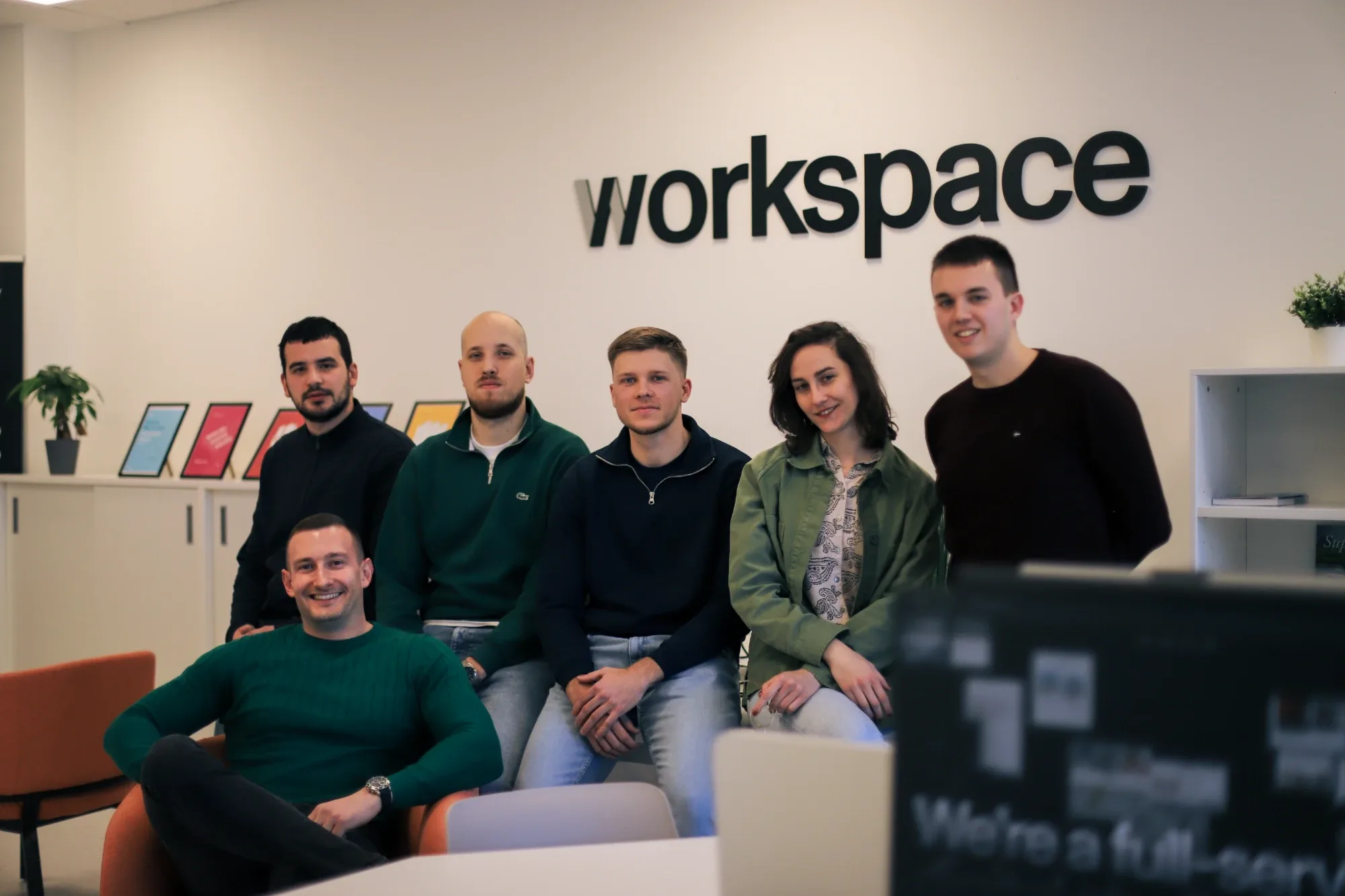
When we moved into the Park in 2024, I had two employees, and today Workspace has 6 employees, 4 external collaborators and several dozen AI agents working with us every day. We build custom software, internal tools, business systems, web platforms and AI solutions, and the four areas we know best are nautical and charter, digital transformation for companies still running on paper and Excel, B2B software for complex operations, and AI working inside products.
Clutch named Workspace a Top Web Design Company in Croatia for 2025, our design work earned an Awwwards Honorable Mention and a CSS Design Awards recognition, and we're members of HUP, CroAI, UNIT and Split Tech City.
Serwizz moves work orders, preventive maintenance and service history off paper and Excel into one place, in the office and on a phone in the field. Serwizz clients report about 20% less time on administration and about 10% more tasks completed per day, and the client base started in nautical companies and is spreading to HVAC, hotels and facility management. Slobodna Dalmacija wrote about Serwizz in May 2025, and Financije.hr followed with an interview in July 2025.
Keeeep pushing
When I left my previous company, my former mentor gave me one piece of advice: you'll hear one formula for success or another and advice from a hundred sides, but it all comes down to one thing, keeeep pushing. On this path I've had wins and failures, and moments when I asked myself whether I'd made the right call and whether working for someone else would have been easier, and then I remember where I started and where I am now, and I keep pushing.
If you're weighing the same jump, from a job to your own company or from an obrt to a d.o.o., or you're running service and maintenance on paper and Excel, write to us. If you're in Split, the coffee at Tehnološki park Split is on me.