
Croatia's draft national AI plan puts EUR 932 million on the table until 2032, so a small company reading the news about it easily concludes there is public money for AI and the first AI project is free to wait for a call. The process everyone agrees should change keeps running the old way, and the owner keeps an eye on the funding calendar in the meantime.
This post looks at what the plan holds for a company of 10 to 50 people, which grants are open at the time of writing (November 16, 2026) and who those grants pay. The line for AI vouchers for small business is about EUR 760,000 in the draft, and the innovation vouchers open today pay only research organisations and innovation hubs. The last round of digitalisation vouchers took months from application to voucher, so waiting for a call has a price, and for most small companies the price is higher than the voucher itself.
We also show how to scope a first AI project so a voucher, if it arrives, is a bonus and never the condition for starting.
What the national AI plan holds for small companies
The draft plan went into public consultation on October 16, which closed on November 15. The plan runs to 2032, and the first action plan covers 2026 to 2028 with about EUR 382 million and 33 measures. The ministry in charge of digital transformation coordinates it, and since the plan is not adopted yet and the consultation report is due on December 16, every amount below comes from the draft.
Most of the money goes elsewhere
Read the plan by who receives the money and you see at least EUR 115 million meant for Croatian companies in strategic European AI projects, plus a separate EUR 36 million for financial instruments for AI startups and scaleups. Further lines fund AI literacy for 7,000 citizens, 10,000 teachers and 5,000 public servants by 2028, a Croatian language model at EUR 2.6 million, and research infrastructure.
The line written for ordinary small and medium companies, the ones who want to put AI into a quote, an invoice check or a customer inbox, is EUR 757,865 for AI vouchers, under the Ministry of Economy. The draft targets at least 50 vouchers by 2028 and plans the call for companies in the first quarter of 2027, with the first awards in the second quarter, but it does not say how large each voucher is or who is allowed to deliver the work.
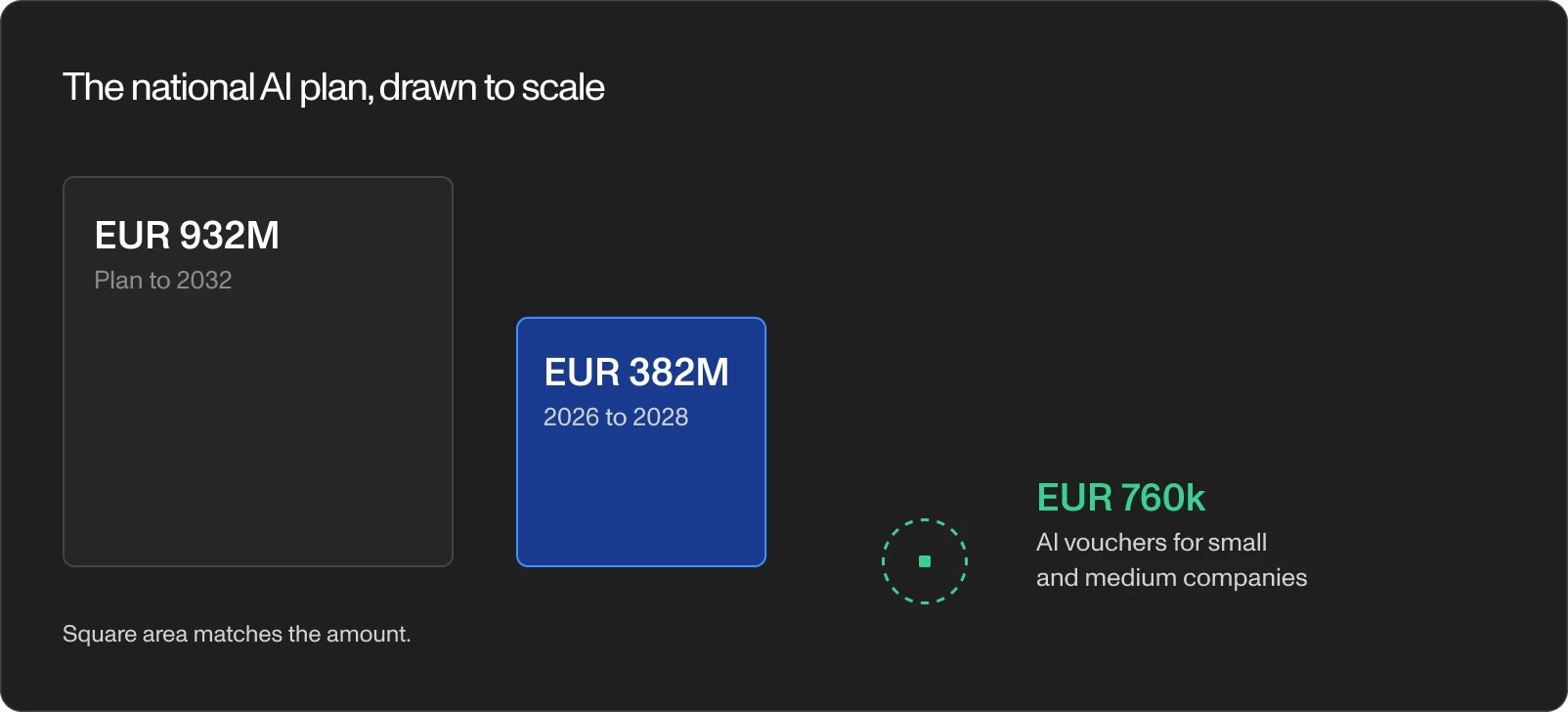
The arithmetic is short: EUR 757,865 spread over 50 vouchers comes to about EUR 15,000 each, and at EUR 10,000 per voucher it covers about 75 companies. A national employers' survey of 781 companies, presented in September, found 62% of Croatian companies already use AI in some form, so from all of this it's safe to expect a long queue for 50 to 75 vouchers.
Open small grants today do not pay for building AI
On November 16, 2026, when this post was written, three grant programmes were open for small companies. The only small one, the innovation voucher, does not pay an outside software team to build an AI feature, and the two larger calls start at EUR 150,000 and need a whole process innovation project.
- The innovation vouchers for SMEs, run by the Ministry of Economy and HAMAG-BICRO, give EUR 2,000 to 10,000 at 50% co-financing, or up to 85% under conditions, until April 30, 2027, or until the money runs out. The provider must be a research organisation, a testing and experimentation infrastructure (digital innovation hubs included) or an innovation cluster licensed for scientific activity. The voucher pays for testing, trials and expert knowledge, and software development is not among the eligible activities.
- INTEGRATOR funds projects from EUR 300,000 to 820,000 with at least two partners and closes on December 31.
- The process innovation call for manufacturers funds projects from EUR 150,000 to 450,000 and also closes on December 31.
The new round of digitalisation vouchers, announced at EUR 10,000 to 30,000, has no published date and dropped out of this year's schedule of calls. HBOR also runs a digital transition loan open to software projects, though a loan has to be paid back.
Vouchers move slower than the problem they fund
The previous digitalisation vouchers ran in three windows in 2023 and 2024. Companies filed about 3,900 applications and signed about 2,000 vouchers, so about half of the applications got nothing. More than three months after the last window closed, some companies were still waiting for their voucher to arrive by post, and companies had to deliver the funded work within 12 months of the voucher.
This is normal for public money, because every call needs rules, an evaluation, a complaint period and a payment claim, and each step protects the budget. The process you wanted to fix keeps running the old way and eating the same hours in the meantime.
The cost of waiting
Start by working out what the process you want to change costs you. Take an illustrative case where one employee spends 15 hours a week copying data from emails and PDFs into a system, at a full cost of EUR 20 per hour, which means the process costs the company EUR 300 a week.
If the AI voucher call opens in the first quarter of 2027 and the voucher arrives three to six months later, the work starts somewhere between mid-April and mid-September 2027. From the day of writing, this means 22 to 44 weeks of waiting, or EUR 6,600 to 13,200 spent on the old process. The voucher you are waiting for is likely worth EUR 10,000 to 20,000, and in the last round about half of the applications got one.
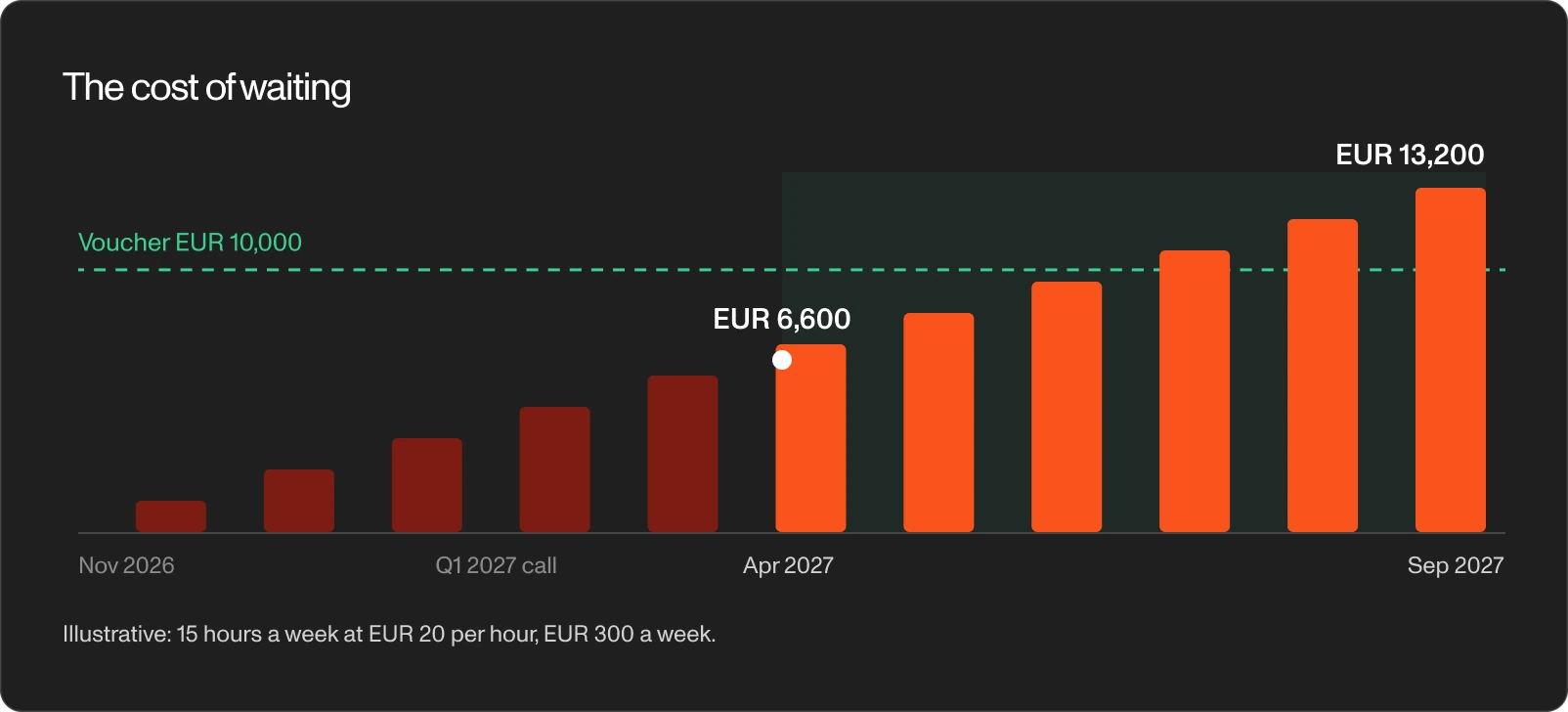
Put your own hours and hourly cost into the calculation and the numbers shift, but you pay the cost of waiting in every case, while in the last round not even every second application got a voucher.
How to start your first AI project without a voucher
The goal is a first project small enough to pay for itself from your own budget and documented well enough to qualify for a call later, if one opens, and both goals point to the same scope.
Pick one process
The national plan talks about transformation, while a small company needs one process to start with, where AI saves hours every week and the data already sits in a system. Good first candidates repeat often and follow rules most of the time: sorting inbound requests, checking supplier invoices against orders, drafting quotes from a price list, answering the same customer questions from your own documents.
A process owned by one named person, with 50 to 100 real records you are able to pull this week, is a better start than a bigger idea. The broader the scope, the closer the cost gets to the grant thresholds and the more the project depends on someone else's calendar.
Scope the first step against the weekly cost
Use the weekly cost from the calculation above as the basis for the budget, which puts a EUR 300 a week process at about EUR 15,000 a year. A first step of two weeks of assessment and a short pilot on real records should cost a fraction of this sum and show whether the process is worth touching at all.
If it is, the build comes with a return calculation based on your own numbers, which is what any later grant application asks for anyway. If it isn't, you spent a small amount to learn it and did not wait a year for the answer.
Use the innovation voucher where it fits
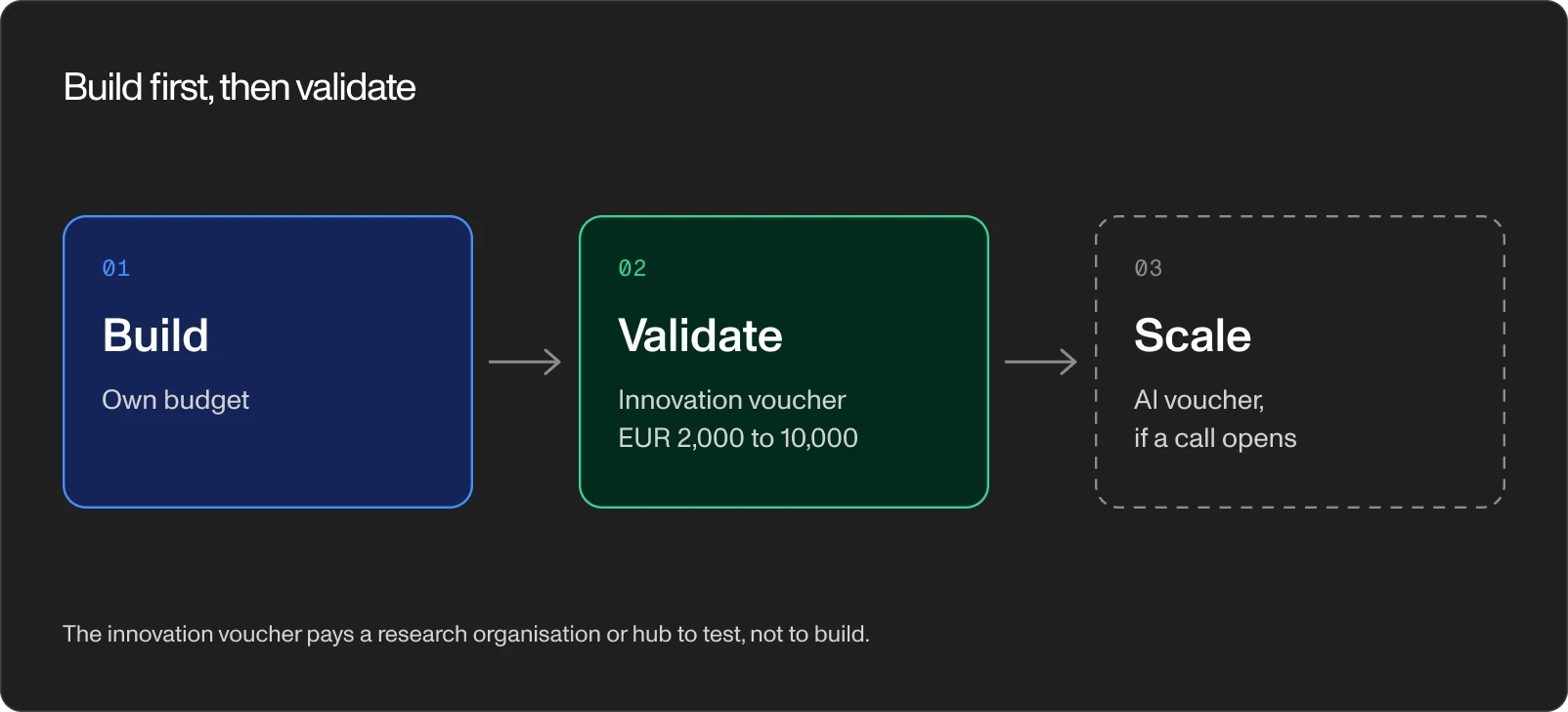
The innovation voucher is useful for testing, because it pays a research organisation, a digital innovation hub or a cluster to check a finished solution. A small company with an AI prototype uses it to have a hub test the prototype on real data, check accuracy against a sample or review the model choice. The voucher covers 50%, or up to 85% under conditions, of EUR 2,000 to 10,000, the provider delivers the service within 120 days of the voucher, and you get the money back within 50 days of your claim, after you have paid the provider in full.
The right order is build first, then validate with the voucher, not the other way round.
Prepare for the AI voucher without depending on it
If the AI voucher call opens in the first quarter of 2027 as planned, the companies ready to apply on the first day will have three things: a described process with weekly volume and cost, a pilot result on their own records, and a named provider with a scope and a price. A company starting now has all three by spring, while a company waiting for the call starts writing them after the call opens, and the money for 50 to 75 vouchers goes fast.
Keep the paperwork simple: one page is enough, with a description of the process, the records you tested, the result in hours or errors and the next step with its cost. This page serves your own decision first and an application second.
Know what grants never cover
Grants pay for projects with a start, an end and a report, but they do not pay for the person on your team who owns the process after launch, for the weekly check of AI output or for the hours your staff spend learning a new way of working. Budget those yourself from day one, with or without a voucher.
How we scope a first AI project at Workspace
Before any pilot with a small company we run a one-process AI audit, where in about two weeks we score six candidate processes and check one of them against real records, so the company knows whether the process is worth automating before it invests. In our work, companies have come to us more than once with dozens of pages of detailed specifications, which would turn into offers of EUR 100,000 and more, even though the first version needed only part of it. Knowing this number matters, because no voucher in the calls open today comes anywhere near it.
When a client asks us about vouchers, our answer stays the same: if the first step pays for itself within a year, start now and count the voucher as a bonus if it arrives. A process which only makes sense with a grant, on the other hand, is the wrong first candidate for AI.
Start with one process
The AI voucher line for small business is about EUR 760,000 in the draft plan. The open innovation vouchers pay only for validating a solution, and the last voucher round left about half of the applications without a voucher. Pick one process, work out what it costs you every week and scope the first step so it pays for itself, and you will have the numbers ready if the call opens in 2027.
Want help picking the process and scoping the first step? Reach out to book a discovery session.